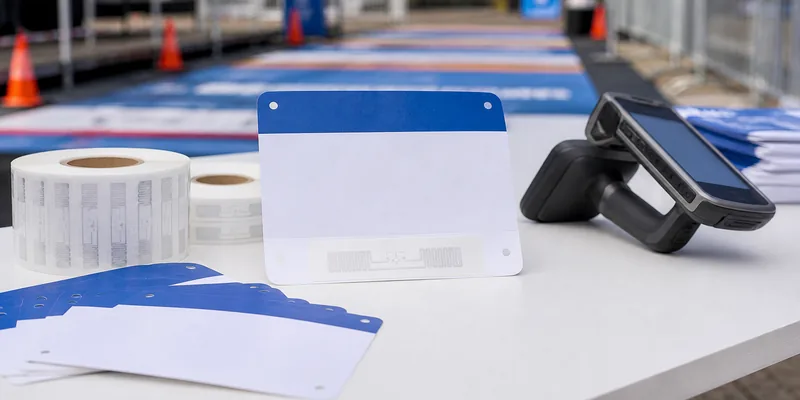
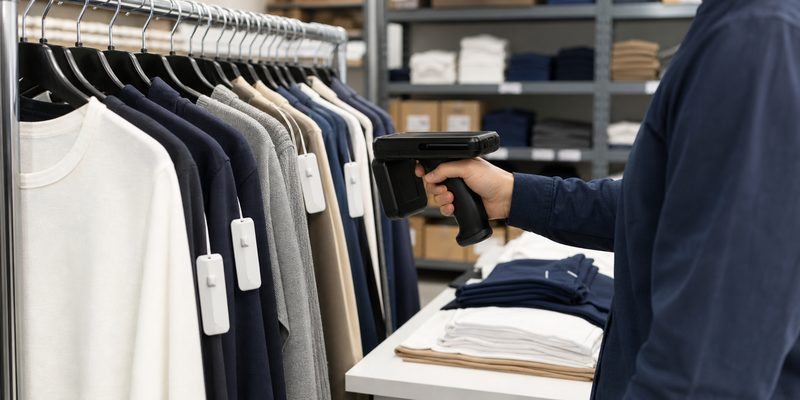
RFID apparel tags are usually chosen after a retailer has already decided that barcode-only counting is too slow for item-level inventory. The harder decision is the tag specification. A paper hang tag, pressure-sensitive RFID label, woven care label, or washable textile tag can all carry an RFID inlay, but they do not behave the same on racks, folded stacks, cartons, checkout counters, or return workflows.
For most apparel retail inventory projects, passive UHF is the starting point because it supports fast item-level reads without line-of-sight scanning. That does not make every UHF tag suitable for every garment. Buyers still need to define the garment type, tag position, inlay size, printing layout, encoding rule, packaging format, and pilot test conditions before ordering bulk tags.
Choose the tag format around the retail workflow
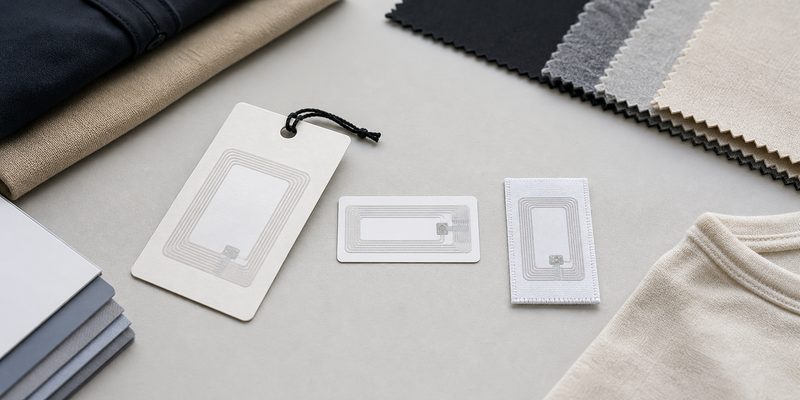
If the tag is removed before the customer wears the garment, a printed RFID hang tag is often the practical choice. If the tag must be applied to packaging, polybags, cartons, or simple product labels, an adhesive RFID label may be easier to print and apply at scale. If the tag needs to remain with the item for returns, rental, uniform management, or post-sale identification, a sewn label or washable textile tag may be more suitable.
The right decision starts with the object being tagged, not with the chip alone. A strong RFQ should explain whether the project covers source tagging at the factory, warehouse receiving, store cycle counts, checkout, loss-prevention support, returns, or a mix of these workflows. WXR can then match the tag construction to clothing RFID tags, printable labels, inlays, or more durable formats.
RFID apparel tag formats compared
| Format | Best fit | What to confirm before ordering |
|---|---|---|
| RFID hang tag | Retail apparel, footwear, accessories, source-tagged goods | Card material, hole position, string or fastener, print artwork, barcode match, EPC encoding, packing sequence |
| Adhesive RFID label | Polybags, cartons, packaging, simple item labels | Face stock, adhesive, liner, printer compatibility, label pitch, roll direction, surface material |
| Sewn fabric RFID label | Returns, rental apparel, uniforms, items that keep identification after sale or issue | Sewing position, washing exposure, consumer notice, comfort, care-label requirements, read angle |
| Washable laundry-style tag | Hotel uniforms, hospital garments, commercial laundry, reusable textiles | Attachment method, washing process, pressure, chemicals, temperature exposure, reader setup |
| Hard tag or reusable tag | Loss-prevention support, high-value apparel, reusable fixtures | Removal process, EAS/RFID relationship, customer workflow, reuse management |
Frequency and chip selection for apparel inventory
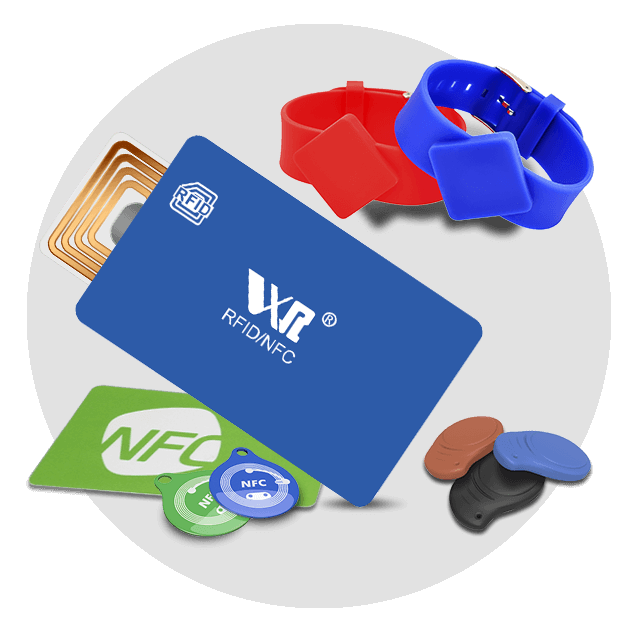
Item-level apparel inventory normally points toward 860-960 MHz UHF RFID tags because handheld readers, tunnels, gates, and packing stations can read many tags in one operation. HF or NFC can still be useful for short-range phone interaction, product authentication, or membership-style experiences, but they are usually not the first choice for rapid rack or carton counting.
Chip selection should follow the data plan. If the retailer, brand owner, or system integrator requires EPC-based identification, confirm the EPC scheme, company prefix, item reference, serial range, filter value, and whether SGTIN-96 is enough. If the project needs extra user memory, password control, or serialized TID readback, document that before selecting the inlay. A tag that reads well but cannot carry the required data structure will still create rework.
Printing and encoding details buyers often miss
RFID apparel tags often need to match visual and digital identities at the same time. The printed side may include a logo, size, color, SKU, barcode, price, care information, or a human-readable serial. The RFID side may carry EPC data, a serial number, or a project-specific code that links to an ERP, WMS, POS, or inventory platform.
Before production, prepare one source file that connects printed values with encoded values. Do not leave this mapping to email screenshots. For factory source tagging, also confirm whether tags should be packed by SKU, size, color, carton, store destination, or roll sequence. This matters when a distribution center expects the first physical tag in a carton to match the first line in an ASN or packing list.
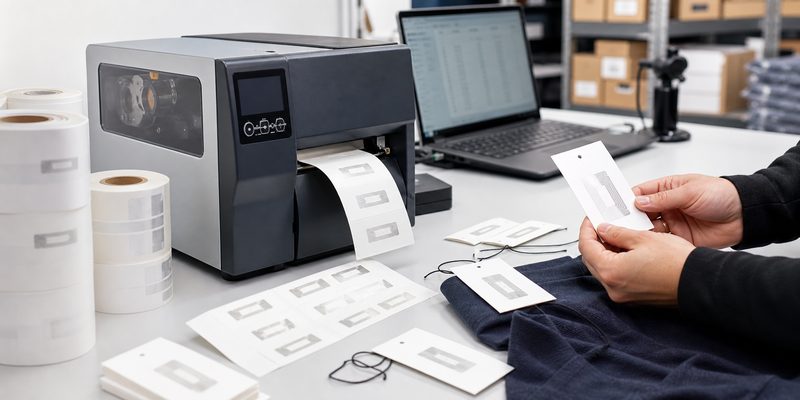
Where tag placement changes read performance
Garments create different RF conditions depending on material, folding, density, and nearby fixtures. A hang tag hanging freely on a shirt may read differently from the same inlay pressed inside a dense carton of denim. Shoes, bags, metallic accessories, foil packaging, liquid cosmetics, and thick stacks can also change performance. This is why a sample test should include the real product mix, not only one loose tag on a desk.
For adhesive labels and converted tags, review the RFID sticker and label structure, adhesive surface, and liner format. For brands or converters building their own labels, compare wet and dry RFID inlay options before choosing the finished label construction.
Sample testing checklist before bulk production
- Test the tag on each major garment category: shirts, denim, coats, shoes, bags, accessories, uniforms, or mixed products.
- Scan hanging racks, folded stacks, polybags, master cartons, and any dense packing method used in the real workflow.
- Use the actual handheld reader, fixed antenna, tunnel, gate, or packing bench configuration where possible.
- Check whether the printed barcode and RFID EPC point to the same SKU or item record.
- Confirm whether the customer can remove the tag, and whether care-label or consumer-notice requirements apply.
- Inspect print durability, hole strength, adhesive hold, sewing position, and tag comfort if the tag stays on the garment.
- Record failed reads by item type and tag position so the supplier can adjust inlay size, orientation, or format.

RFID does not automatically replace every existing retail control. Many stores still compare RFID with barcode workflows, and some environments use RFID alongside EAS. The useful question is where RFID gives item-level visibility: receiving, store replenishment, stock counts, fitting-room exceptions, returns, and carton verification. For a broader retail-system comparison, see WXR’s guide to RFID tags vs EAS tags and the basic difference between RFID and barcode workflows.
For inventory and asset programs, the tag choice also connects to the reporting goal. If the buyer only needs fast stock counts, a removable UHF hang tag may be enough. If the same identifier must support returns, warranty, rental, or circularity, the project may need a tag that remains with the garment and a clearer data-retention policy. For broader non-apparel projects, WXR’s asset tracking RFID tags page may help compare other tag formats.
Send these details when asking for samples or a quote: application goal, garment category, tag format, frequency, chip or memory requirement, EPC/serialization rule, printing artwork, barcode requirements, attachment method, expected reader type, packing format, sample quantity, and test environment. Include photos of the garment, tag location, cartons, racks, and any difficult surfaces.
WXR can help compare UHF hang tags, RFID labels, inlays, clothing tags, and washable options based on the retail workflow. Share your artwork, encoding file, reader setup, and sample-test plan through the WXR contact page before bulk production so the first sample round answers the important questions.
FAQ
What RFID tag is best for apparel retail inventory?
A passive UHF RFID hang tag is a common starting point for apparel retail inventory because it can support item-level rack, carton, and stockroom reads. Adhesive labels, sewn labels, or washable tags may be better when the tag must attach to packaging or remain with the garment.
UHF is usually preferred for retail inventory counting because it supports longer-range, multi-item reading. HF or NFC fits short-range phone interaction, authentication, or access-style use cases. Confirm the reader system before choosing the frequency.
Many retail projects encode an EPC that links to SKU and serial data in the inventory system. The exact scheme depends on the retailer mandate, GS1/EPC requirements, database design, and whether extra memory is needed.
Yes. Apparel RFID hang tags and labels can combine printed barcode, SKU, size, color, logo, and human-readable serial information with RFID encoding. The printed data and encoded data should be checked together during sample approval.
How should apparel RFID samples be tested?
Test samples on real garments, racks, cartons, folding patterns, and reader setups. Record read gaps by product type and tag position, then adjust the inlay, orientation, attachment, or label material before bulk production.