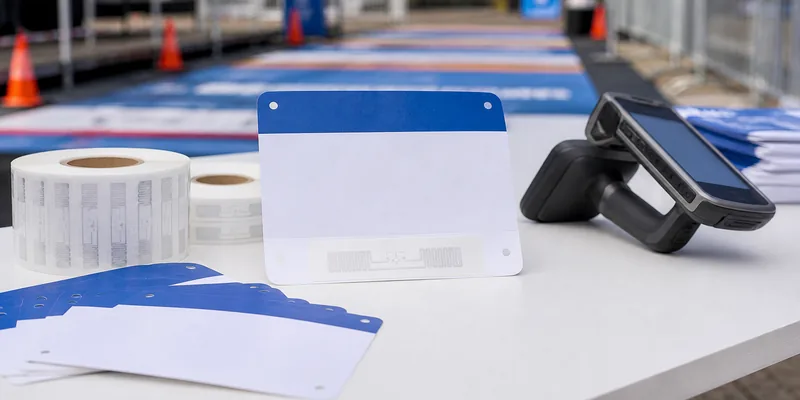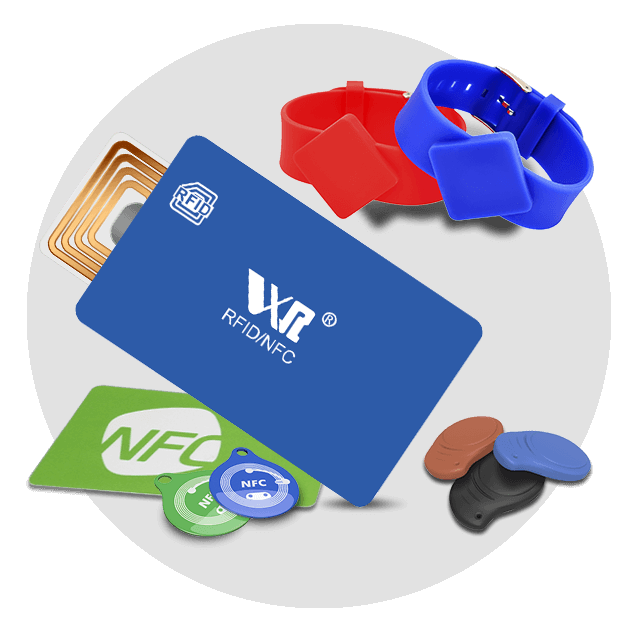
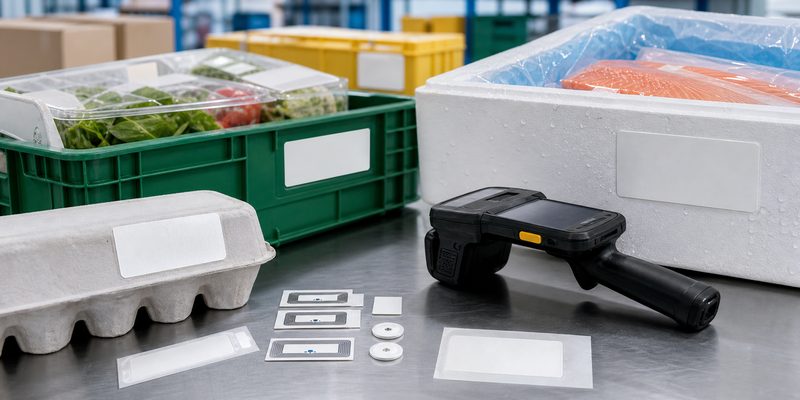
RFID tags for food traceability work best when the tag is selected around the package, the read point, and the data workflow, not around the tag name alone. A label that reads well on a dry corrugated carton may perform differently on a wet plastic crate, a foil-lined insulated box, or a tray of liquid-rich products. Before ordering at scale, buyers should define the traceable unit, confirm the packaging surface, and test samples in the same cold room, dock door, or conveyor environment where the tags will be used.
For most food logistics projects, passive UHF RFID labels are the first option to evaluate because they support fast carton, case, tote, and pallet identification. HF or NFC tags may still fit short-range consumer interaction, authentication, or item-level scenarios. The right choice depends on whether the project needs fast inventory capture, chain-of-custody visibility, consumer engagement, or durable asset tracking for reusable crates.
Which RFID Tag Fits Food Traceability?
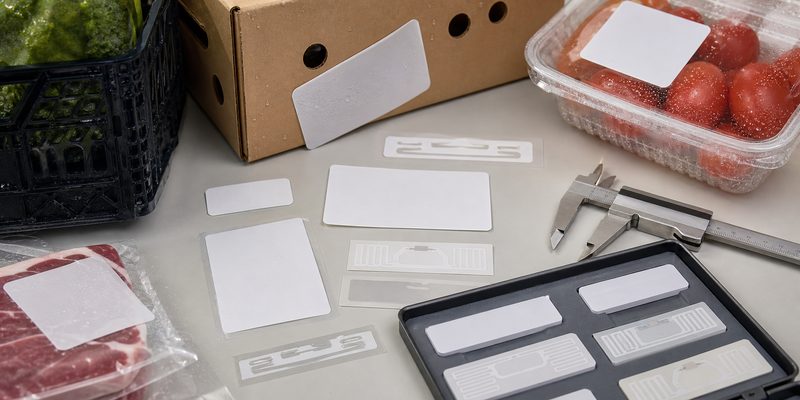
Start with a custom RFID sticker or label for dry cartons and outer packaging. Move to synthetic face stock, stronger adhesive, or a sealed tag when moisture, condensation, abrasion, or repeated handling is expected. Use RFID inlays when a converter needs to build the antenna and chip into a printed label, smart package, or custom label format.
If the project tracks cases, totes, and pallets through receiving or dispatch, evaluate UHF RFID tags. If the project links consumers to product information by phone, NFC may be a better fit. If the tag must stay on a reusable plastic crate, cold box, or metal rack, ask whether a more durable waterproof RFID tag or asset tag is needed instead of a disposable paper label.
Define the Traceable Unit Before Choosing the Label
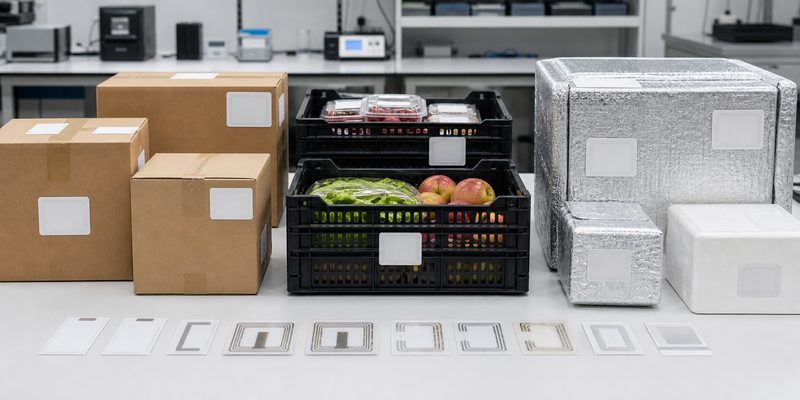
Food traceability can happen at several levels: item, inner pack, case, tote, pallet, or returnable transport item. Do not choose the smallest tag by default. A carton-level label may be enough for warehouse receiving, while item-level tagging can add unnecessary cost and complexity if the system only needs lot movement and dispatch confirmation.
Before requesting samples, document what the software will identify: EPC number, SKU, lot, batch, production date, shelf-life status, shipment ID, or a reusable container ID. In many deployments, the RFID tag stores a unique identifier while the detailed food traceability data lives in the backend system. That keeps tag encoding simple and makes data corrections easier than writing every attribute onto tag memory.
Packaging Surface Changes RFID Performance
RFID performance is strongly affected by the surface behind the label. Corrugated cardboard is usually easier than foil-lined insulation, metalized film, liquid-heavy products, or wet plastic. Food packaging also introduces condensation, frost, grease, cleaning chemicals, and rough handling. These conditions may damage the face stock, weaken adhesive, or change how the antenna couples with the package.
For carton labels, confirm the label size, antenna orientation, adhesive, and printer compatibility. For plastic crates, check whether the label will be disposable or must survive many wash and return cycles. For insulated boxes or foil surfaces, test actual samples because the reflective material can reduce read consistency. For liquid-rich products, avoid assuming that a label proven on dry goods will work without adjustment.
Food Traceability RFID Tag Options
| Tag option | Best fit | What to confirm before ordering |
|---|---|---|
| Paper UHF RFID label | Dry cartons, cases, pallet labels, general warehouse flow | Printer method, adhesive, read distance target, EPC encoding rule |
| Synthetic RFID label | Chilled cartons, damp handling, plastic packaging, condensation risk | Face stock, adhesive, moisture exposure, freezer or refrigeration test |
| Custom RFID inlay | Smart packaging, label converting, brand-specific label sizes | Antenna size, chip, converting process, placement tolerance |
| Durable asset RFID tag | Reusable crates, totes, cold boxes, racks, food service containers | Mounting method, washing process, impact risk, read points |
| NFC tag | Consumer product information, authentication, digital packaging | Phone compatibility, surface material, NDEF data, lock or rewrite plan |
Cold Chain Projects Need Material Testing, Not Just Chip Selection
Cold chain RFID labels should be tested through the same temperature, humidity, and handling pattern expected in the project. A sample that reads on a room-temperature carton may curl, lose adhesion, or scan inconsistently after refrigeration or condensation. The practical test is simple: apply labels to real packages, cool them under normal conditions, move them through the actual read point, and record missed reads by label position and package type.
When the package is exposed to water, ice, cleaning, or repeated handling, ask for material samples before choosing the chip. In many projects, upgrading from paper to synthetic construction solves more problems than changing memory size. If the project also needs temperature history, that becomes a separate sensing requirement and should be confirmed with the system provider before assuming a standard passive RFID label can record environmental data.
Plan Encoding and Numbering Early
Food traceability fails when the physical label and the database do not match. Decide how each RFID label will be encoded before production: EPC format, serial number range, SKU mapping, lot relationship, or integration file. If printed human-readable numbers, barcodes, or QR codes are used alongside RFID, the printed value and encoded value must be mapped and checked together.
For higher-volume runs, prepare a packing and verification file. The file should show which EPCs are assigned to which roll, box, carton batch, or shipment. This helps receiving teams diagnose problems quickly if a label roll is damaged, a number range is duplicated, or a packing sequence does not match the software import.
Where to Place RFID Labels on Food Packaging
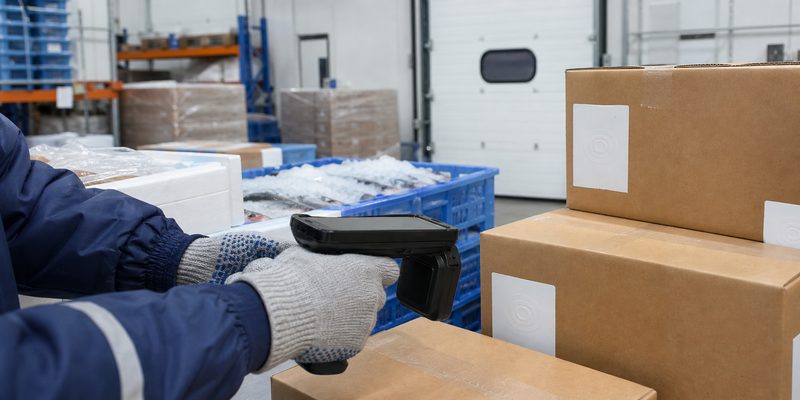
Label placement should be chosen with the read point in mind. A handheld inventory count, a conveyor antenna, and a dock-door portal all energize the tag from different angles. Place test labels on multiple sides of the carton or crate, then compare read consistency while the package is stacked, wrapped, chilled, or moved at normal speed.
Avoid placing the RFID label across folds, crushed corners, wet seams, foil edges, or areas that workers handle heavily. If the package is shrink-wrapped, test whether the wrap changes the label angle or traps moisture. For reusable crates, confirm whether the tag should be recessed, riveted, embedded, or protected by a label window.
Sample Test Checklist Before Bulk Production
- Confirm the traceable unit: item, case, tote, pallet, or reusable asset.
- List the packaging surfaces: cardboard, plastic, foam, foil, glass, or metalized film.
- Choose the read method: handheld, desktop reader, conveyor, shelf, or dock-door portal.
- Test labels after refrigeration, condensation, stacking, and normal handling.
- Check EPC encoding, printed number mapping, and software import files.
- Compare label placement options using the real reader and antenna setup.
- Review whether disposable labels or durable reusable tags fit the cost model.
- Keep failed samples and read logs so the supplier can adjust antenna size, material, or adhesive.
Common Mistakes in Food RFID Label Sourcing
The first mistake is treating food traceability as a software-only project. Software matters, but poor tag placement or weak adhesive can break the workflow before the data reaches the system. The second mistake is copying a label from a different product category. A label used on dry apparel packaging may not be suitable for chilled seafood cartons, plastic produce crates, or insulated delivery boxes.
The third mistake is skipping printed-number control. Warehouse and quality teams still need a visible fallback when a reader, handheld, or network connection is unavailable. The fourth mistake is overloading tag memory. In many food applications, a clean unique ID plus reliable backend data is easier to manage than writing too much changing information onto the tag.
How WXR Can Support Food Traceability Tag Projects
WXR can help buyers compare RFID labels, inlays, NFC tags, waterproof tags, and reusable asset tag formats for food packaging and cold-chain workflows. Share your packaging material, target read point, frequency preference, label size, printing method, encoding rule, and sample test conditions. For projects that involve warehouse visibility, reusable containers, or carton-level tracking, WXR can also help compare asset tracking RFID tags and related label options.
If you are still defining the system, start with the basics in RFID asset tracking and compare RFID with barcode workflows in RFID vs barcode. When you are ready to test samples, contact WXR with your package photos, read-point design, and encoding requirements.
FAQ
RFID tags are commonly applied to outer packaging, cartons, crates, and logistics units rather than directly to food. Buyers should confirm material, adhesive, placement, and any market-specific packaging requirements before rollout.
Should food traceability use UHF RFID or NFC?
Use UHF RFID when the goal is fast warehouse, case, tote, or pallet identification. Use NFC when phone interaction, consumer engagement, or short-range authentication is the main requirement.
Can RFID labels work in refrigerated or frozen logistics?
They can, but the label material, adhesive, package surface, and read point must be tested under real cold-chain conditions. Do not rely only on room-temperature sample reads.
Most projects encode a unique ID such as an EPC and keep detailed product, lot, shipment, or status data in the backend system. This should be agreed before label production.
Do RFID labels replace barcodes in food logistics?
Not always. Many projects use RFID for fast non-line-of-sight capture and keep barcodes or printed numbers as a visible fallback for exception handling.
Schema Recommendation
Use Article schema for the main post and FAQPage schema for the visible FAQ section.
Facts and Assumptions to Verify
This article assumes a passive RFID label or tag project for food packaging, logistics, or reusable container tracking. Confirm local food-contact packaging rules, adhesive requirements, temperature exposure, reader setup, software data model, and any customer compliance requirements before mass production.