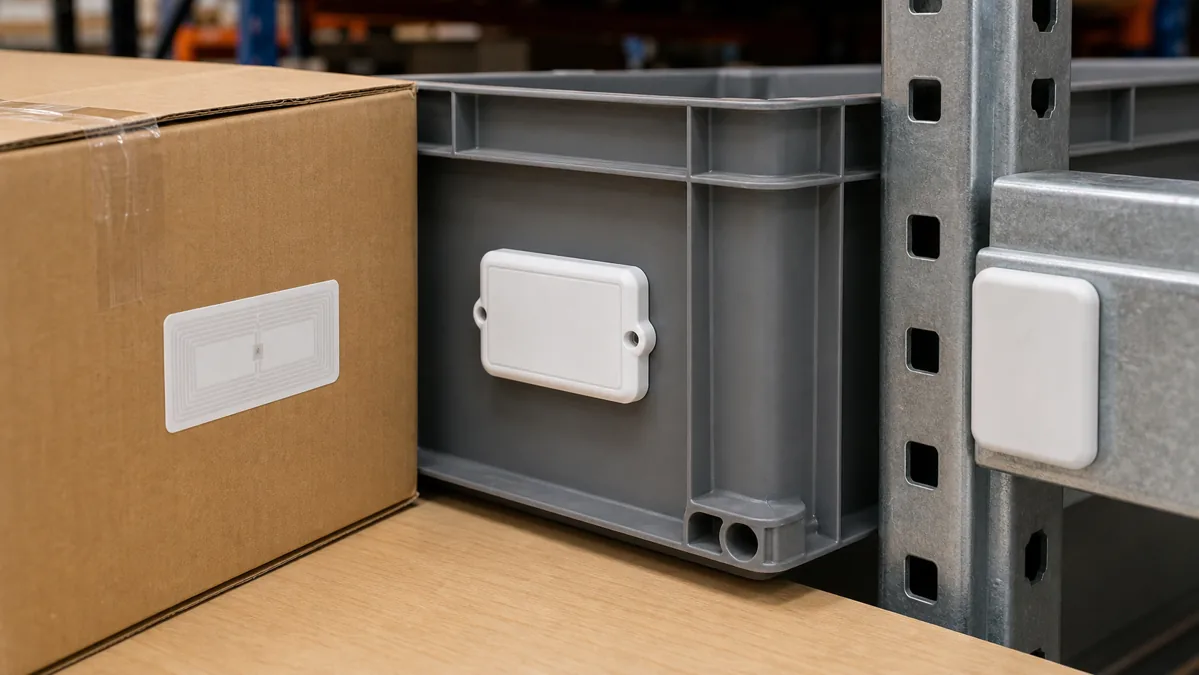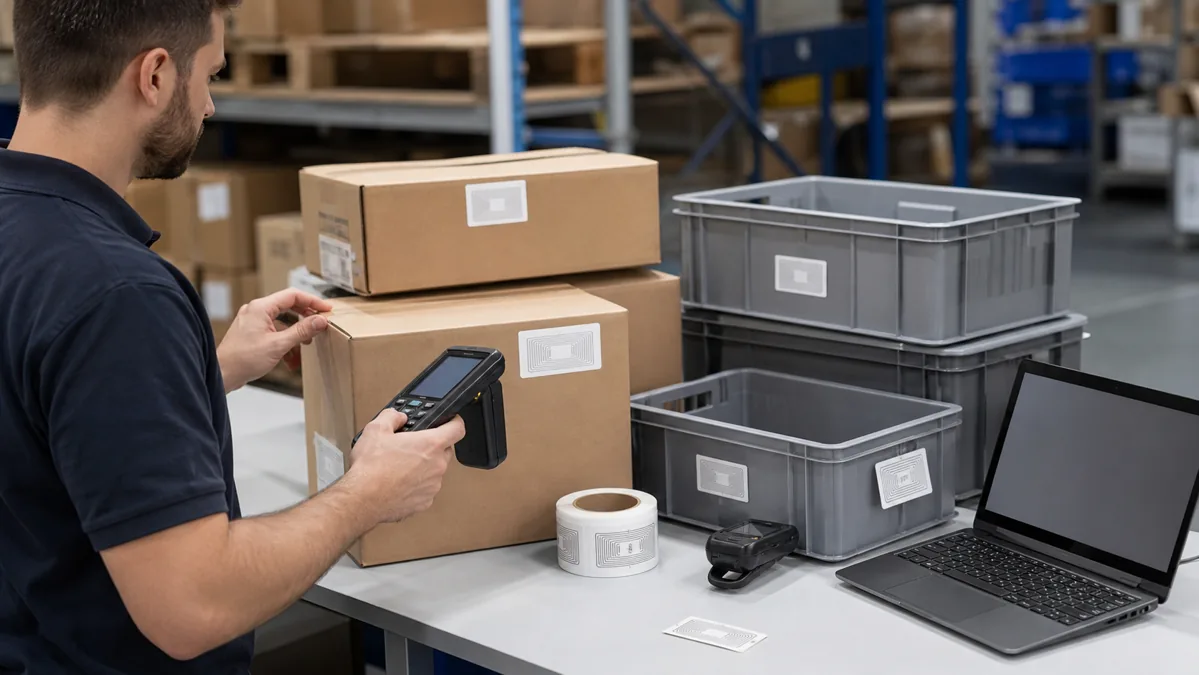
UHF RFID

Take a break and read all about it

RFID Tags for Food Traceability: Packaging and Cold Chain Checklist

RFID tags for food traceability work best when the tag is selected around the package, the read point, and the data workflow, not around the tag name alone. A label that reads well on a dry corrugated carton may perform differently on a wet plastic crate, a foil-lined insulated box, or a tray of liquid-rich products. Before ordering at scale, buyers should define the traceable unit, confirm the packaging surface, and test samples in the same cold room, dock door, or conveyor environment where the tags will be used.

For most food logistics projects, passive UHF RFID labels are the first option to evaluate because they support fast carton, case, tote, and pallet identification. HF or NFC tags may still fit short-range consumer interaction, authentication, or item-level scenarios. The right choice depends on whether the project needs fast inventory capture, chain-of-custody visibility, consumer engagement, or durable asset tracking for reusable crates.

Which RFID Tag Fits Food Traceability?

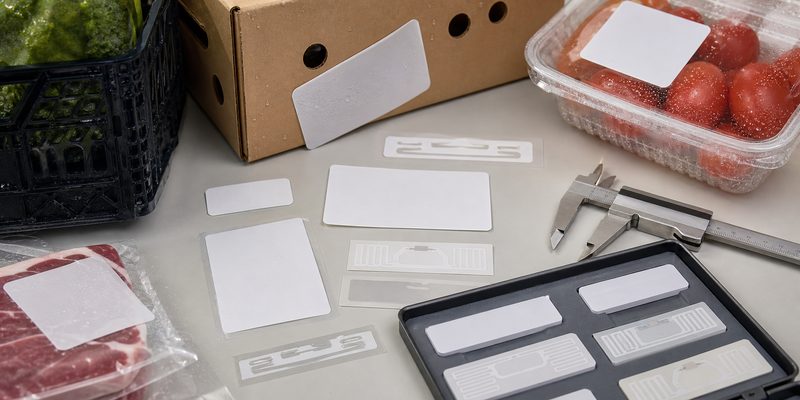
Start with a custom RFID sticker or label for dry cartons and outer packaging. Move to synthetic face stock, stronger adhesive, or a sealed tag when moisture, condensation, abrasion, or repeated handling is expected. Use RFID inlays when a converter needs to build the antenna and chip into a printed label, smart package, or custom label format.

If the project tracks cases, totes, and pallets through receiving or dispatch, evaluate UHF RFID tags. If the project links consumers to product information by phone, NFC may be a better fit. If the tag must stay on a reusable plastic crate, cold box, or metal rack, ask whether a more durable waterproof RFID tag or asset tag is needed instead of a disposable paper label.
RFID

Define the Traceable Unit Before Choosing the Label

Food traceability can happen at several levels: item, inner pack, case, tote, pallet, or returnable transport item. Do not choose the smallest tag by default. A carton-level label may be enough for warehouse receiving, while item-level tagging can add unnecessary cost and complexity if the system only needs lot movement and dispatch confirmation.

Before requesting samples, document what the software will identify: EPC number, SKU, lot, batch, production date, shelf-life status, shipment ID, or a reusable container ID. In many deployments, the RFID tag stores a unique identifier while the detailed food traceability data lives in the backend system. That keeps tag encoding simple and makes data corrections easier than writing every attribute onto tag memory.

Packaging Surface Changes RFID Performance

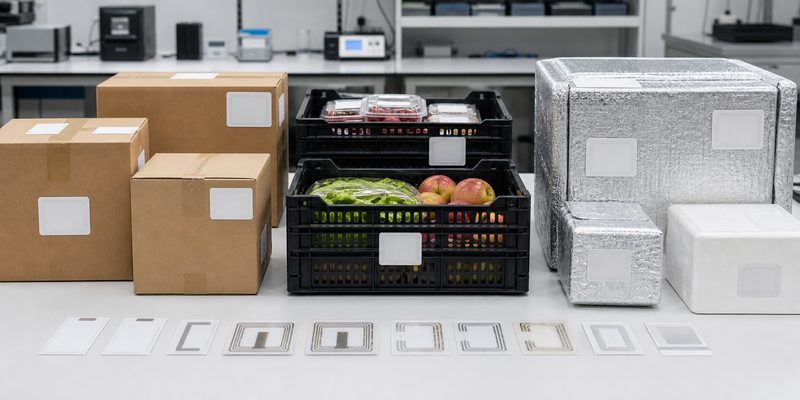
RFID performance is strongly affected by the surface behind the label. Corrugated cardboard is usually easier than foil-lined insulation, metalized film, liquid-heavy products, or wet plastic. Food packaging also introduces condensation, frost, grease, cleaning chemicals, and rough handling. These conditions may damage the face stock, weaken adhesive, or change how the antenna couples with the package.

For carton labels, confirm the label size, antenna orientation, adhesive, and printer compatibility. For plastic crates, check whether the label will be disposable or must survive many wash and return cycles. For insulated boxes or foil surfaces, test actual samples because the reflective material can reduce read consistency. For liquid-rich products, avoid assuming that a label proven on dry goods will work without adjustment.

Food Traceability RFID Tag Options

Tag option Best fit What to confirm before ordering
Paper UHF RFID label Dry cartons, cases, pallet labels, general warehouse flow Printer method, adhesive, read distance target, EPC encoding rule
Synthetic RFID label Chilled cartons, damp handling, plastic packaging, condensation risk Face stock, adhesive, moisture exposure, freezer or refrigeration test
Custom RFID inlay Smart packaging, label converting, brand-specific label sizes Antenna size, chip, converting process, placement tolerance
Durable asset RFID tag Reusable crates, totes, cold boxes, racks, food service containers Mounting method, washing process, impact risk, read points
NFC tag Consumer product information, authentication, digital packaging Phone compatibility, surface material, NDEF data, lock or rewrite plan

Cold Chain Projects Need Material Testing, Not Just Chip Selection

Cold chain RFID labels should be tested through the same temperature, humidity, and handling pattern expected in the project. A sample that reads on a room-temperature carton may curl, lose adhesion, or scan inconsistently after refrigeration or condensation. The practical test is simple: apply labels to real packages, cool them under normal conditions, move them through the actual read point, and record missed reads by label position and package type.

When the package is exposed to water, ice, cleaning, or repeated handling, ask for material samples before choosing the chip. In many projects, upgrading from paper to synthetic construction solves more problems than changing memory size. If the project also needs temperature history, that becomes a separate sensing requirement and should be confirmed with the system provider before assuming a standard passive RFID label can record environmental data.

Handheld

Plan Encoding and Numbering Early

Food traceability fails when the physical label and the database do not match. Decide how each RFID label will be encoded before production: EPC format, serial number range, SKU mapping, lot relationship, or integration file. If printed human-readable numbers, barcodes, or QR codes are used alongside RFID, the printed value and encoded value must be mapped and checked together.

For higher-volume runs, prepare a packing and verification file. The file should show which EPCs are assigned to which roll, box, carton batch, or shipment. This helps receiving teams diagnose problems quickly if a label roll is damaged, a number range is duplicated, or a packing sequence does not match the software import.

Where to Place RFID Labels on Food Packaging

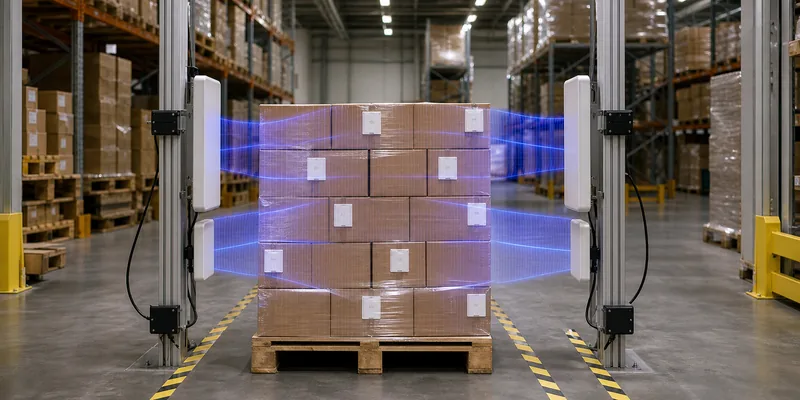
Label placement should be chosen with the read point in mind. A handheld inventory count, a conveyor antenna, and a dock-door portal all energize the tag from different angles. Place test labels on multiple sides of the carton or crate, then compare read consistency while the package is stacked, wrapped, chilled, or moved at normal speed.

Avoid placing the RFID label across folds, crushed corners, wet seams, foil edges, or areas that workers handle heavily. If the package is shrink-wrapped, test whether the wrap changes the label angle or traps moisture. For reusable crates, confirm whether the tag should be recessed, riveted, embedded, or protected by a label window.

Sample Test Checklist Before Bulk Production

  • Confirm the traceable unit: item, case, tote, pallet, or reusable asset.
  • List the packaging surfaces: cardboard, plastic, foam, foil, glass, or metalized film.
  • Choose the read method: handheld, desktop reader, conveyor, shelf, or dock-door portal.
  • Test labels after refrigeration, condensation, stacking, and normal handling.
  • Check EPC encoding, printed number mapping, and software import files.
  • Compare label placement options using the real reader and antenna setup.
  • Review whether disposable labels or durable reusable tags fit the cost model.
  • Keep failed samples and read logs so the supplier can adjust antenna size, material, or adhesive.
RFID

Common Mistakes in Food RFID Label Sourcing

The first mistake is treating food traceability as a software-only project. Software matters, but poor tag placement or weak adhesive can break the workflow before the data reaches the system. The second mistake is copying a label from a different product category. A label used on dry apparel packaging may not be suitable for chilled seafood cartons, plastic produce crates, or insulated delivery boxes.

The third mistake is skipping printed-number control. Warehouse and quality teams still need a visible fallback when a reader, handheld, or network connection is unavailable. The fourth mistake is overloading tag memory. In many food applications, a clean unique ID plus reliable backend data is easier to manage than writing too much changing information onto the tag.

How WXR Can Support Food Traceability Tag Projects

WXR can help buyers compare RFID labels, inlays, NFC tags, waterproof tags, and reusable asset tag formats for food packaging and cold-chain workflows. Share your packaging material, target read point, frequency preference, label size, printing method, encoding rule, and sample test conditions. For projects that involve warehouse visibility, reusable containers, or carton-level tracking, WXR can also help compare asset tracking RFID tags and related label options.

If you are still defining the system, start with the basics in RFID asset tracking and compare RFID with barcode workflows in RFID vs barcode. When you are ready to test samples, contact WXR with your package photos, read-point design, and encoding requirements.

FAQ

Are RFID tags safe to use on food packaging?

RFID tags are commonly applied to outer packaging, cartons, crates, and logistics units rather than directly to food. Buyers should confirm material, adhesive, placement, and any market-specific packaging requirements before rollout.

Should food traceability use UHF RFID or NFC?

Use UHF RFID when the goal is fast warehouse, case, tote, or pallet identification. Use NFC when phone interaction, consumer engagement, or short-range authentication is the main requirement.

Can RFID labels work in refrigerated or frozen logistics?

They can, but the label material, adhesive, package surface, and read point must be tested under real cold-chain conditions. Do not rely only on room-temperature sample reads.

What data should be encoded into food traceability RFID tags?

Most projects encode a unique ID such as an EPC and keep detailed product, lot, shipment, or status data in the backend system. This should be agreed before label production.

Do RFID labels replace barcodes in food logistics?

Not always. Many projects use RFID for fast non-line-of-sight capture and keep barcodes or printed numbers as a visible fallback for exception handling.

Schema Recommendation

Use Article schema for the main post and FAQPage schema for the visible FAQ section.

Facts and Assumptions to Verify

This article assumes a passive RFID label or tag project for food packaging, logistics, or reusable container tracking. Confirm local food-contact packaging rules, adhesive requirements, temperature exposure, reader setup, software data model, and any customer compliance requirements before mass production.

RFID Read Range: What Affects It and How to Test Tags Before Buying

RFID read range is not a fixed number printed on a tag. It is the distance at which a specific tag, reader, antenna, object surface, and environment work together reliably enough for the job. A UHF label that reads well on a carton may fail on a metal tool. An NFC tag that works perfectly with a phone may be the wrong choice for warehouse portals. Before buying custom RFID tags in bulk, treat read range as a test result, not only as a catalog claim.

This guide explains the main variables that affect RFID read range and gives buyers a practical sample-testing plan. If you are still comparing frequency options, start with WXR’s guide to LF, HF, and UHF frequency differences, then use the checklist below to prepare your project details.

RFID tags tested on metal cardboard and plastic surfaces

Quick Answer: What Controls RFID Read Range?

The biggest factors are frequency, tag antenna size, chip sensitivity, reader power, antenna type, mounting surface, tag orientation, surrounding metal or liquid, and how many tags must be read at the same time. Passive tags also need enough energy from the reader field to power the chip, so a longer read zone usually requires the whole system to be designed around that goal.

For buyers, the practical question is not “What is the maximum range?” A better question is: “Can this tag be read consistently at our required point in our real workflow?” That wording keeps the discussion grounded in cartons, tools, garments, books, vehicles, laundry bags, or other real assets instead of ideal lab conditions.

Frequency Sets the Starting Point

RFID frequency has a major influence on read distance and use case. LF tags are commonly used for close-range ID, animal tags, and access systems. HF and NFC tags are often chosen for cards, library labels, phones, and short-range user interactions. UHF RFID is usually selected when projects need longer read zones, faster inventory scanning, or portal/handheld reading across many items.

FrequencyTypical buyer goalRead range noteWhat to confirm
LFAccess ID, animal ID, close-range credentialsShort, controlled readsReader compatibility and chip type
HF / NFCCards, library, phone tap, smart packagingShort to moderate near-field readsISO standard, memory, phone or reader behavior
UHFWarehouse, apparel, asset tracking, portalsLonger read zones are possible but environment-sensitiveSurface, antenna, orientation, region, and software workflow

If the project requires long-distance inventory or asset tracking, review WXR’s UHF RFID tags and asset tracking RFID tags. If the project is phone interaction or short-range authentication, an NFC or HF format may be more suitable even if it does not read from far away.

Surface Material Can Change Everything

The same RFID tag can behave differently on cardboard, plastic, glass, metal, fabric, or liquid-filled packaging. Metal can detune a normal RFID antenna or reflect the signal in unexpected ways. Liquids and the human body can absorb RF energy, especially when the tag sits very close to water-rich materials. Curved surfaces can also bend the antenna and change performance.

This is why a buyer should tell the supplier the exact mounting surface before asking for samples. For metal tools, IT equipment, gas cylinders, racks, or machinery, compare normal labels with anti-metal RFID tags. For cartons, packages, documents, and general logistics, RFID stickers and labels may be a better balance of size, cost, printing, and encoding.

Tag Size, Antenna Design, and Chip Choice Matter

A larger antenna can often harvest and return more energy than a very small antenna, but size is not the only factor. The tag’s antenna design, chip sensitivity, tuning, material stack, and adhesive all affect performance. A tiny jewelry tag, a laundry button tag, and a large UHF label should not be expected to deliver the same read range, even if they use the same frequency family.

Chip selection matters too. Some projects need EPC memory only; others need TID verification, user memory, password locking, or NFC NDEF data. If read distance and memory are both important, discuss both requirements early. Do not choose a chip only because it is familiar; choose the tag format and chip together.

RFID sample testing kit for buyer validation

Reader, Antenna, and Software Settings Also Affect Results

Read range is a system result. A tag tested with a high-performance fixed reader and a properly aimed antenna may perform differently with a low-power handheld reader. Antenna polarization, reader power, reader sensitivity, cable loss, scan speed, and filtering rules can all change what the operator sees. In dense tag populations, software settings and anti-collision behavior also affect read reliability.

For this reason, the best sample test uses the reader and antenna that will be used in the real project. If that is not possible, record the test reader model, antenna type, power setting, distance, angle, and environment so results are not misread later.

A Practical RFID Read Range Testing Plan

Before mass production, prepare a small test plan instead of checking one tag once. The goal is to find a reliable operating window, not a one-time maximum distance.

  • Define the required read point. For example: handheld scan at shelf level, portal read at dock door, phone tap on packaging, or access credential at a reader.
  • Test on the real asset. Attach the sample to the actual material: metal, plastic, textile, glass, paper, wood, or liquid container.
  • Try several positions. Move the tag across corners, flat areas, curved areas, and hidden locations if the project needs embedded tagging.
  • Test orientation. Rotate the tag and asset because antenna alignment can change results.
  • Measure repeatability. Check whether the tag reads consistently across multiple passes, not only once at a best-case angle.
  • Simulate the real workflow. Add nearby items, stacked cartons, moving pallets, people, metal shelves, or other interference sources.
  • Record encoding and printing needs. Confirm EPC, UID, serial number, QR code, barcode, logo printing, and lock settings before production.
RFID warehouse portal read zone test with tagged cartons

Common Mistakes When Comparing RFID Read Distance

The first mistake is comparing tags without specifying the surface. A normal UHF label on a carton and an on-metal tag on a steel tool are solving different problems. The second mistake is chasing the longest possible read range when the workflow needs a controlled read zone. For access control, payment, or item confirmation, too much range can create accidental reads.

The third mistake is ignoring regional frequency and reader settings. UHF RFID regulations vary by market, so a tag and reader setup should match the deployment region. The fourth mistake is treating a sample result as permanent without checking production variables such as printing, adhesive, lamination, encoding, and final mounting method.

What Information Should You Send to an RFID Tag Supplier?

To get useful tag recommendations, share the application, target read distance, reader type, frequency preference, asset material, tag size limit, environment, attachment method, quantity, printing, encoding, and packaging requirements. Photos or drawings of the asset help the supplier avoid unsuitable tag formats early.

WXR can help compare custom RFID labels, inlays, anti-metal tags, cards, wristbands, laundry tags, and other tag formats based on your surface and workflow. If read range is critical, contact WXR with your test conditions and sample requirements before mass production.

FAQ

What is a good RFID read range?

A good read range is the distance that reliably supports your workflow. A phone-tap NFC project may need only close contact, while a UHF warehouse portal may need a larger read zone. The right answer depends on frequency, reader, antenna, tag, surface, and environment.

Why does my RFID tag read well in one place but poorly in another?

The mounting surface, nearby metal or liquid, tag angle, reader antenna position, and surrounding interference may have changed. Test the tag on the real item and in the real workflow before deciding it is suitable.

Do anti-metal RFID tags always read farther?

No. Anti-metal RFID tags are designed for metal surfaces, but the best choice still depends on tag size, reader setup, mounting position, and target read zone. They should be compared with samples on the actual asset.

Can WXR customize RFID tags for a target read distance?

WXR can recommend tag formats, chips, materials, printing, encoding, and sample options based on your application. Exact performance should be verified with samples in your reader environment before rollout.

Schema Recommendation

Recommended schema: Article and FAQPage. The FAQPage schema should match only the visible FAQ questions and answers above.

Facts and Assumptions to Verify

  • Exact read range must be verified with the buyer’s reader, antenna, asset surface, and environment.
  • Regional UHF frequency rules and reader power settings should be confirmed for the deployment market.
  • Chip availability, material stack, encoding, printing, and locking requirements should be confirmed before production.

How to Choose UHF RFID Tags for Warehouse Asset Tracking

UHF RFID warehouse asset tracking labels on cartons, pallets, and reusable containers

Quick answer: the best UHF RFID tag for warehouse asset tracking is the one that reads reliably on your real asset, at your real read point, with your actual reader and software. For cartons and paper labels, a UHF RFID label or wet inlay may be enough. For reusable plastic totes, pallets, tools, cages, metal racks, or outdoor assets, buyers often need a more durable hard tag, long-range RFID tag, or anti-metal construction.

Do not choose the tag only by chip name or advertised read range. In warehouse projects, performance depends on the asset surface, tag orientation, reader antenna, read zone design, encoding plan, attachment method, and how the item moves through receiving, storage, picking, packing, and dispatch.

Start With the Warehouse Workflow, Not the Tag

Before comparing samples, define what the RFID system must identify. A warehouse may tag individual products, cartons, pallet loads, returnable containers, tools, IT assets, bins, trolleys, or metal equipment. Each object creates a different tag requirement.

If the reader is installed at a dock door, the tag may need to read while the pallet is moving. If staff use handheld readers, the tag can be placed where scanning is easier and more controlled. If assets are stacked, wrapped, wet, or close to metal, a standard label that works on a test table may fail in daily use.

For most bulk warehouse and logistics workflows, UHF RFID tags are the practical starting point because they support longer read zones and multiple-tag reading. HF or NFC tags still have a place when the process needs close-range, one-at-a-time confirmation.

Common UHF RFID Tag Options for Warehouse Assets

Tag option Best fit What to confirm before ordering
UHF RFID label or sticker Cartons, cases, packaging, paper labels, short-to-medium life assets Face material, adhesive, antenna size, printer compatibility, encoding format, roll direction
RFID wet inlay Label converting, custom printed labels, smart packaging, high-volume logistics labels Dry or wet construction, antenna design, chip model, label conversion process
Hard asset tag Reusable totes, pallets, bins, tools, equipment, rough handling Housing material, attachment method, cleaning exposure, impact and abrasion risk
Anti-metal RFID tag Metal racks, cages, tools, machinery, IT assets, metal containers Mounting surface, spacer or ferrite layer, orientation, adhesive or screw fixing
Long-range RFID tag Dock doors, yards, high shelves, reusable transport items Reader antenna layout, allowed read distance, region frequency, asset motion, missed-read tolerance
UHF RFID label, hard tag, and anti-metal tag formats compared for warehouse assets

Surface Material Changes the Tag Choice

Carton, plastic, wood, metal, glass, liquid-filled packaging, fabric, and rubber do not behave the same around UHF RFID. Paper cartons are usually the easiest surface for a UHF label. Plastic totes can work well, but curved areas, ribs, stacking contact, and cleaning can affect both reading and adhesion. Metal is the most common reason a normal UHF label disappoints, because the surface can detune the antenna.

If assets include metal shelving, tools, cages, or machinery, compare anti-metal RFID tags instead of trying to make a standard label work by trial and error. If assets will be handled outdoors or cleaned frequently, review waterproof RFID tag options as part of the sample set.

Do Not Separate Encoding From Tag Selection

A warehouse RFID tag is useful only when the code on the tag matches the business record in the system. For a closed-loop warehouse, the EPC may represent an internal asset ID, carton ID, bin ID, or pallet ID. For GS1-based supply chains, teams may need EPC schemes connected to identifiers such as trade items, logistics units, locations, returnable assets, or individual assets.

The practical buyer question is simple: who creates the numbering file, who encodes the tags, who verifies every tag, and how will duplicate IDs be prevented? If printed QR codes or serial numbers are used on the same label, the printed value and encoded EPC should be checked against one master file.

For background on tag memory, see WXR’s guides to EPC memory on an RFID tag and TID memory in RFID.

Warehouse Read Zones Decide Whether the Tag Works

A good tag can still fail in a poor read zone. Dock doors, conveyors, packing benches, handheld scan routes, forklift paths, and storage aisles all create different RF conditions. Reader power, antenna polarization, antenna height, cable loss, tag orientation, item speed, nearby metal, and tag density can all change results.

This is why fixed read points should be tested with real movement, not only static samples. A tag that reads when a box is held in front of the antenna may not read when the same box is wrapped on a pallet, surrounded by other cartons, or passing quickly through a doorway.

Buyer Checklist Before Requesting Samples

  • Asset type: carton, pallet, bin, tote, cage, tool, rack, equipment, or reusable transport item.
  • Surface: cardboard, plastic, wood, metal, painted metal, glass, textile, rubber, or mixed materials.
  • Environment: indoor, outdoor, wet, cold storage, dusty, washable, chemical exposure, or rough handling.
  • Read method: handheld reader, fixed dock door, conveyor, gate, shelf antenna, or packing station.
  • Data plan: EPC format, printed serial number, QR code, barcode, TID capture, lock requirement, and duplicate-control process.
  • Attachment: adhesive label, cable tie, rivet, screw, embedded tag, hang tag, or protective holder.
  • Production format: rolls, sheets, individual tags, pre-printed labels, pre-encoded tags, or blank tags for in-house encoding.
Warehouse RFID sample testing workflow with tagged cartons and handheld UHF reader

Sample Testing Plan for Warehouse RFID Tags

Ask for a small set of tag formats rather than one sample. For example, compare a standard UHF label, a larger antenna label, a hard tag, and an anti-metal tag if your assets include mixed materials. Apply each sample to the real asset surface and place it where staff or equipment can actually support it.

Then test the complete workflow: receiving, put-away, picking, packing, dispatch, return, cleaning, and exception handling. Record missed reads, duplicate reads, unreadable orientations, adhesive failure, damage, and any locations where operators naturally cover or bend the tag.

For high-volume projects, also test printing and encoding. Confirm that the RFID printer or encoder can write the selected chip, that the label feeds correctly, and that the exported data file matches the warehouse software import format.

How WXR Supports Warehouse Asset Tracking Projects

WXR can help project buyers compare asset tracking RFID tags, RFID stickers and labels, RFID inlays, anti-metal tags, and custom UHF tag formats based on the asset surface and read zone.

For a useful recommendation, send WXR your asset photos, dimensions, surface material, target read points, reader type, encoding format, printing requirement, quantity, and testing environment. That information is more valuable than asking for a generic long-range RFID tag without the warehouse context.

FAQ

Are UHF RFID tags best for warehouse asset tracking?

Often yes, especially when the project needs longer read zones or multiple-tag reading. The final choice still depends on the asset surface, reader setup, regional frequency requirements, and testing results.

Can a standard RFID label work on metal warehouse assets?

Usually not reliably. Metal can detune a standard UHF label. For metal racks, tools, cages, and equipment, test anti-metal RFID tags or on-metal label constructions.

Should RFID warehouse tags be pre-encoded?

Pre-encoding can reduce setup work when the numbering file is ready and the supplier can verify each tag. In-house encoding may be better when IDs are assigned during receiving or commissioning. The key is to prevent duplicate or mismatched IDs.

What affects UHF RFID read range in a warehouse?

Read range depends on tag antenna, chip, reader power, antenna placement, orientation, asset material, nearby metal or liquid, tag density, motion, and local radio rules. Always test samples in the real warehouse workflow.

Choosing UHF RFID tags for warehouse asset tracking is not a one-line specification. Start with the object, surface, read zone, encoding plan, and attachment method. Then compare samples under real warehouse conditions before mass production.

Need help choosing warehouse RFID tags? Contact WXR with your application details, asset photos, read points, encoding needs, and sample-testing plan so the team can recommend suitable tag formats.

What Is EPC Memory on an RFID Tag?

EPC memory on an RFID tag is the memory area that usually stores the main item identifier read during a UHF RFID inventory. In EPC Gen2 / RAIN RFID tags, EPC memory is memory bank 01. It contains the Electronic Product Code or another item identifier, plus protocol control data that helps the reader understand the tag response.

For most warehouse, retail, logistics, apparel, and asset-tracking projects, EPC memory is the first memory area you care about because it answers the operational question: Which item is this?

That sounds simple, but EPC memory is often misunderstood. It is not the same as TID memory, it is not a general-purpose database, and it is not only a visible ?EPC number.? The EPC bank includes CRC, PC bits, the EPC payload, and sometimes extended protocol control bits. Understanding those pieces helps you choose the right chip, encode tags correctly, and avoid duplicate or unreadable IDs.

This guide focuses on UHF EPC Gen2 / RAIN RFID tags. LF, HF, and NFC tags may use different memory terms and data structures.

How UHF RFID Tag Memory Is Organized

UHF EPC Gen2 tags are commonly described with four memory banks:

Memory bank Main purpose Typical project use
Reserved memory Stores access and kill passwords Password protection and controlled operations
EPC memory Stores the item identifier and related control data Inventory, asset ID, carton ID, pallet ID, product serialization
TID memory Identifies the tag IC itself Chip verification, tag model checking, anti-cloning support
User memory Optional extra application memory Batch data, maintenance notes, configuration data, service records

The important distinction is this: EPC memory identifies the object, while TID memory identifies the tag chip. User memory is optional and should only be used when the workflow really needs extra data stored on the tag.

What Exactly Is Stored in EPC Memory?

In the GS1 EPC Gen2 standard, EPC memory starts with protocol fields before the actual EPC payload:

EPC memory section What it does
StoredCRC A 16-bit error-checking value used by the tag/reader protocol
StoredPC / PC bits Protocol control data, including the length of the EPC field
EPC payload The item identifier, such as an SGTIN-96 or another valid encoding
Optional XPC bits Extended protocol control bits used by some tag features

In everyday RFID language, people often say ?write the EPC? or ?read the EPC.? Technically, the EPC memory bank contains more than the EPC payload. Your encoder, printer, reader, and software hide much of this complexity, but the structure still matters when you select chips or troubleshoot encoding. For example, the PC length field tells the reader how many 16-bit words make up the EPC portion returned during inventory.

EPC Memory vs TID Memory vs User Memory

EPC, TID, and User memory are often mentioned together because buyers need to know where data should live.

Question Best memory area
What product, asset, carton, or pallet is this? EPC memory
What RFID chip is inside this tag? TID memory
Do I need extra data stored directly on the tag? User memory
Do I need password-related control? Reserved memory

EPC memory is usually writable before deployment. A supplier, RFID printer, encoder, or system integrator can encode EPC values so each tag has a useful identity in the software system.

TID memory is usually programmed by the chip manufacturer and is not intended for ordinary rewriting. It can help verify chip type or detect basic EPC copying. For more detail, see WXR?s guide to TID memory in RFID.

User memory is optional. Some chips have none; some have enough for short application data. If your database already stores item details, EPC memory is usually enough.

How Much EPC Memory Do RFID Tags Have?

Many UHF RFID projects use 96-bit EPC values, especially SGTIN-96 in GS1-based supply chain systems. But 96 bits is not the only possible EPC length. EPC Gen2 standards allow different EPC lengths, and GS1 TDS defines multiple binary encoding schemes. The practical answer depends on the chip model, encoding scheme, reader software, and whether the project follows GS1 standards or a closed-loop internal numbering system.

When buying UHF RFID tags, do not only ask for ?EPC support.? Confirm EPC memory size, required encoding format, pre-encoding before shipment, locking after encoding, and whether your software expects hexadecimal EPC, a GS1 EPC URI, or another format. These checks prevent a common deployment problem: tags can be readable, yet still encoded in a way the business system cannot use.

Can EPC Memory Be Rewritten?

Often yes, but it depends on the chip and lock state. Many UHF RFID tags allow EPC memory to be written during commissioning and rewritten later if the memory has not been permanently locked.

For supply chain, retail, and anti-tampering use cases, EPC memory is often locked after encoding to prevent accidental overwrites or duplicated IDs. For reusable assets, containers, or work-in-process tags, a project may keep EPC memory writable or use User memory for changing data.

If rewriting matters, read WXR?s related guide: Can RFID tags be rewritten? The practical rule is simple: confirm writable memory, password behavior, lock options, and reader support before mass production.

What Should You Encode in EPC Memory?

Encode a stable identifier that your software can map to the real-world object, such as a retail item, carton, pallet, reusable container, tool, garment, jewelry item, or internal factory asset.

Avoid storing long descriptions, customer records, maintenance history, or constantly changing workflow data in EPC memory. In most RFID systems, the tag stores the ID and the database stores the details. If the application needs extra on-tag data, choose a chip with User memory and test whether reading that memory slows down the workflow.

Buyer Checklist for EPC Memory

Before ordering RFID inlays, labels, or hard tags, confirm:

  1. Frequency and protocol: UHF EPC Gen2 / ISO 18000-63 / RAIN RFID.
  2. Chip model and EPC memory size.
  3. Required EPC encoding format, such as GS1 SGTIN-96 or internal asset ID.
  4. Whether each EPC value must be unique across the full project.
  5. Whether the tags should be pre-encoded before shipment.
  6. Whether EPC memory should remain writable, locked, or permanently locked.
  7. Whether TID should be read and stored together with EPC.
  8. Whether the item surface requires anti-metal RFID tags or custom UHF labels.
  9. Whether the reader, printer, and software can verify every encoded tag.

For high-volume projects, always test samples with your real reader, antenna, software, item material, orientation, and environment before mass production.

How WXR Can Help

WXR manufactures custom RFID and NFC products for distributors, system integrators, and project buyers. For UHF projects, WXR can help compare chip options, EPC memory requirements, antenna formats, label materials, printing, serial/QR marking, encoding, and sample testing.

If you are planning asset tracking, apparel inventory, logistics labels, industrial tagging, or custom RFID stickers, send WXR your application, item surface, chip requirement, encoding format, quantity, and testing environment. The team can recommend a tag format and sample plan before mass production.

Contact WXR to discuss EPC encoding, UHF RFID tag selection, and custom sample testing.

Conclusion

EPC memory is the main item-identification memory bank on a UHF EPC Gen2 / RAIN RFID tag. It stores the EPC or item identifier plus protocol control data used during fast RFID inventory.

For buyers, the practical questions are simple: how much EPC memory does the chip provide, what encoding format does your software expect, should the EPC be locked, and do you also need TID or User memory? Answer those questions before ordering, and your RFID tags will be easier to encode, read, verify, and scale.

FAQ

Is EPC memory the same as RFID memory?

No. EPC memory is one memory bank on UHF EPC Gen2 RFID tags. Gen2 tags can also include Reserved memory, TID memory, and optional User memory.

Is EPC memory used on NFC tags?

Usually no. EPC memory is mainly discussed in UHF EPC Gen2 / RAIN RFID systems. NFC tags use different memory structures and data formats, such as NDEF.

Can two RFID tags have the same EPC?

Technically yes, if the encoding process is poorly controlled. In real inventory systems, each physical item should have a unique EPC or a unique database mapping.

Should I store product details in EPC memory?

Usually no. Store a stable ID in EPC memory and keep product details in your software database. Use User memory only when the process truly needs extra data stored on the tag.

Can EPC memory be locked?

Yes, many UHF RFID chips support locking or permanent locking. Exact behavior depends on the chip, reader, software, and password configuration.

Technical verification sources: GS1 EPC/RFID Gen2 standard, GS1 EPC Tag Data Standard, and RAIN Alliance overview.

The Basics of UHF Passive RFID Tags

With the increasing use of radio frequency identification (RFID) technology, more and more companies are using UHF passive RFID tags to track and monitor their goods. UHF stands for ultra-high frequency and uses radio waves to identify objects from a distance. This technology is used in many industries including retail, transportation, hospitality, and healthcare. Let’s take a look at the basics of UHF passive RFID tags and how they can be used in your business.

What is a UHF Passive RFID Tag?

A UHF passive RFID tag is made up of two components: an integrated circuit (IC) chip that stores data about the product it is attached to and an antenna that sends out a signal with information about the product. The IC chip does not require any power source or battery, which makes it inexpensive to manufacture. The antenna picks up signals from a reader device. These signals activate the IC chip so the reader can retrieve data stored on it.

Benefits of Using UHF Passive RFID Tags

UHF passive RFID tags are beneficial because they allow you to track products quickly and accurately from a distance without manual intervention. They also provide real-time information about where inventory is located within your facility or warehouse, eliminating guesswork and reducing human error. Additionally, they are able to store large amounts of data such as product serial numbers, expiration dates, batch numbers, etc., providing you with detailed information about your products or assets.

Applications of UHF Passive RFID Tags

UHF passive RFID tags can be used in many different industries for a variety of applications such as asset tracking, inventory control, product authentication/anti-counterfeiting measures, animal identification/tracking, patient identification/tracking in hospitals or clinics, vehicle tracking systems for fleet management purposes, access control systems for secure areas/facilities etc. They can also be used for supply chain management operations such as shipping/receiving processes or customer loyalty programs where customers receive discounts based on their purchase history.

Conclusion: As you can see from this overview of UHF passive RFID tags, there are many benefits to using this type of technology in your business operations. It provides accurate tracking capabilities from a distance without manual intervention while also allowing you to store large amounts of data about your products or assets. Whether you’re looking for improved asset tracking capabilities or customer loyalty programs for repeat customers – these tags offer great potential in streamlining operations and improving customer satisfaction through personalized services!

Ask For A Quick Quote

Your inquiry will be replied within 24 hours! Please pay attention to the email with the suffix “@tag-rfid.com”. If not received, please check your spam email.