RFID labels

Take a break and read all about it

Wet RFID Inlay vs Dry RFID Inlay: Label Converting and RFQ Checklist

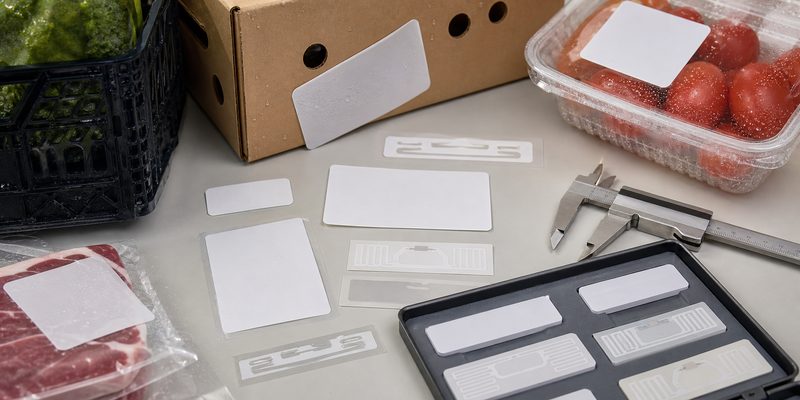
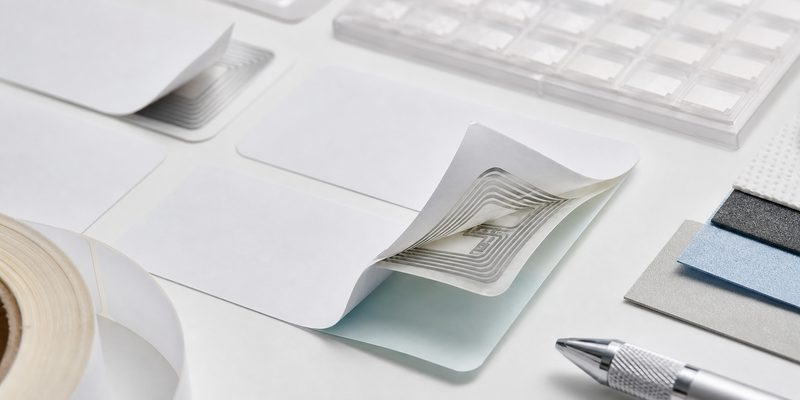
Wet and dry RFID inlays can look similar in a product photo, but they are bought for different production steps. A wet RFID inlay normally includes the chip, antenna, substrate, adhesive, and release liner, so it can be applied or converted into a finished RFID label. A dry RFID inlay is closer to the core chip-and-antenna layer, usually selected by converters or manufacturers that will laminate, embed, or build it into another product.

The best choice is not simply “wet is better” or “dry is cheaper.” It depends on who will convert the material, what surface the tag will identify, which reader system is used, and how printing, encoding, packing, and quality control will be handled before shipment.

Difference: Wet Inlay vs Dry Inlay

Use a wet RFID inlay when you need an adhesive-backed RFID layer for labels, stickers, smart packaging, logistics labels, retail tags, tickets, or other roll-fed converting work. Use a dry RFID inlay when your factory or converter needs the RFID core for lamination into cards, tickets, hang tags, specialty labels, or custom products where the adhesive and face material will be added later.

Decision point Wet RFID inlay Dry RFID inlay
Basic structure Chip and antenna with adhesive and release liner Chip and antenna on a substrate, usually without final adhesive
Typical buyer Label buyer, packaging team, converter needing ready adhesive material Card maker, ticket maker, converter, OEM product manufacturer
Main advantage Faster conversion or application More flexible for custom lamination or embedding
Main risk Wrong adhesive, liner, roll direction, or face material Extra processing responsibility before it becomes a usable tag
What to test Adhesion, print/encode workflow, surface read performance Lamination process, final tag durability, reader performance after conversion

Supplier wording can vary. Before approving a quote, confirm the exact layer stack instead of relying only on the words wet or dry.

Start With the Finished RFID Product

Do not choose an inlay before you define the finished tag. The same UHF or NFC inlay may be converted into a simple logistics label, a branded retail hang tag, a product authentication sticker, a ticket, a library label, or a card insert. Each format changes the material and testing requirements.

For a ready-to-apply label project, buyers often compare RFID stickers and labels with RFID inlays to decide whether WXR should supply the inlay, the converted label, or the final printed and encoded roll. For phone-tap packaging, the discussion may start from NFC tags. For warehouse, apparel, carton, and pallet workflows, UHF RFID tags may be the better starting point.

The useful first question is: what does the buyer need to receive in the box? Blank inlay rolls, printable labels, pre-encoded finished labels, cards, tickets, or a custom tag construction?

What to Specify in an RFID Inlay RFQ

An RFID inlay quote should be more specific than frequency and size. Give the supplier enough information to recommend a construction that can survive conversion and read correctly after it is applied.

Include these details:

  • Application: retail item, carton, asset, document, smart package, ticket, card, apparel label, or another use case.
  • Frequency and protocol: LF, HF/NFC, ISO 15693, ISO 14443A, UHF EPC Gen2, RAIN RFID, or the reader’s required format.
  • Chip requirement: EPC, UID, User memory, NDEF capacity, password use, lock rule, or a named chip model.
  • Antenna size and label dimensions: available space, orientation, and any printer or die-cut limit.
  • Construction: dry inlay, wet inlay, face stock, adhesive, liner, roll core, roll direction, pitch, and finished label format.
  • Surface and environment: paper, plastic, glass, textile, cardboard, liquid package, metal, curved surface, heat, humidity, abrasion, or cleaning exposure.
  • Data and finishing: logo printing, QR code, barcode, serial number, EPC encoding, NDEF URL, readback file, and packing order.
  • Sample plan: final reader, software, product surface, converting process, and acceptance criteria.

When one of these details is unknown, mark it as unknown. Guessing silently creates expensive errors later.
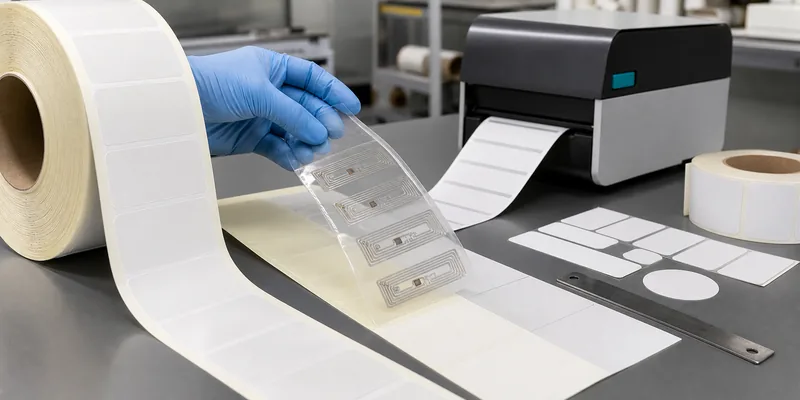
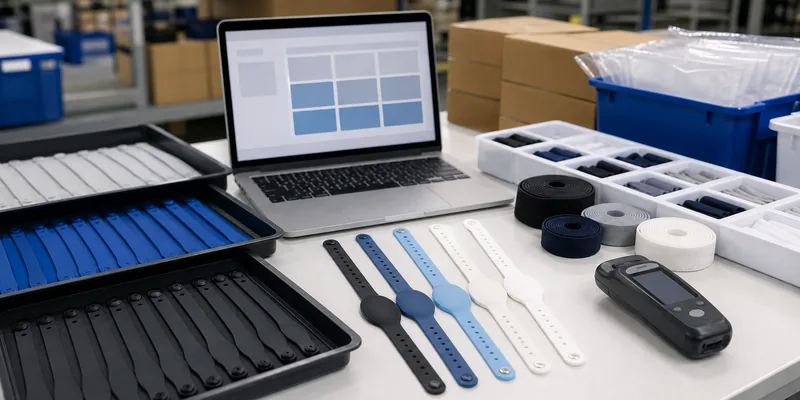
RFID inlay film and blank label rolls prepared for converting

Choose Wet Inlays for Label and Sticker Workflows

A wet RFID inlay is useful when the project needs an adhesive-backed RFID layer that can be laminated under a printable face, die-cut into labels, or applied to a product or package. This is common in retail labeling, smart packaging, carton tracking, event tickets, logistics labels, library stickers, and product information stickers.

Wet inlays are convenient, but they are not automatically finished labels. A buyer still needs to confirm whether the supplied material includes only the inlay and liner, or whether it also includes face stock, printing, die-cutting, encoding, and final roll packing. A roll that is technically correct can still fail in production if the roll direction does not match the printer, the pitch does not match the applicator, or the adhesive is wrong for the surface.

For wet inlay projects, test the final adhesive and final surface. A label that reads well on paper may behave differently on a curved bottle, a foil pouch, a liquid-filled package, or a dense stack of cartons.

Choose Dry Inlays for Custom Integration

A dry RFID inlay is often better when the inlay will be integrated into another product instead of used directly as an adhesive label. Examples include PVC cards, smart tickets, custom hang tags, laminated credentials, embedded packaging, and specialty RFID products where the converter controls the adhesive, face material, encapsulation, or lamination process.

The advantage is flexibility. The risk is that the buyer or converter owns more of the process. Lamination temperature, pressure, material thickness, antenna placement, die-cut position, and protective layers can all affect final performance. If the dry inlay is damaged during conversion or detuned by the final material, the finished tag may not meet the project goal.

Ask for samples in the final construction, not only raw dry inlay sheets.

Frequency and Chip Still Matter

Wet vs dry describes physical construction. It does not replace frequency and chip selection.

HF and NFC inlays at 13.56 MHz are common for phone interactions, smart packaging, access cards, library labels, and short-range identification. UHF inlays are commonly used for retail inventory, logistics, apparel, warehouse labels, asset tracking, and bulk-reading workflows. LF inlays fit some close-range ID and legacy systems.

Reader compatibility comes first. If the installed system requires a specific chip, memory layout, encoding rule, or regional UHF band, the inlay construction must follow that requirement. For background reading, WXR’s guides to what RFID tags are and LF, HF, and UHF frequency differences are useful before final specification.

Sample Testing Before Bulk Rolls

RFID sample testing should copy the real workflow. Test the same inlay, same adhesive or lamination, same face stock, same encoding, same reader, and same object surface that the production order will use.
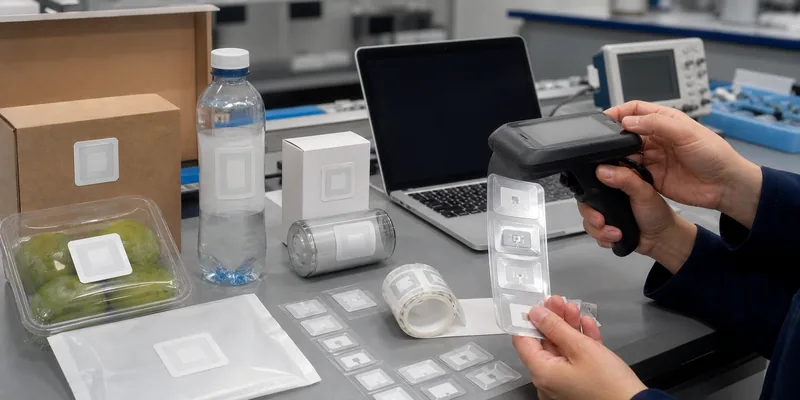
RFID inlay samples tested on packaging surfaces before bulk order

A practical test plan should include:

  1. Single-label reading on the target surface.
  2. Reading after printing, encoding, die-cutting, or lamination.
  3. Multiple-item reads if the workflow requires bulk reading.
  4. Orientation tests from the normal reader angle.
  5. Surface tests on paper, plastic, glass, textile, liquid packaging, or metal when relevant.
  6. Adhesive aging or handling tests when the label will be stored, shipped, bent, cleaned, or touched often.
  7. Readback verification for encoded EPC, UID reference, serial number, barcode, QR code, or NDEF content.

Do not approve an RFID inlay based only on a maximum read range from a clean lab condition. Real performance depends on antenna design, reader power, reader antenna, orientation, nearby tags, surface material, liquid, metal, and software filtering.

Quality Control and Packing Details

RFID inlay and label orders need traceability. If the buyer receives mixed rolls, wrong roll direction, missing encoding records, or unlabeled sample batches, installation becomes slower and error-prone.

Before mass production, agree on:

  • Approved reference sample for each inlay or label type.
  • Roll direction, roll core, outer diameter, pitch, and quantity per roll.
  • Printing artwork and barcode or QR code rules.
  • EPC or NDEF encoding file format.
  • Readback file and failed-tag handling.
  • Packing labels by chip, size, branch, serial range, or project batch.
  • Replacement allowance for field testing and damaged labels.

WXR can help compare custom RFID inlays, converted RFID labels, NFC stickers, UHF labels, and other finished RFID tag formats based on your application, chip, material, printing, encoding, and testing environment.

Common Buying Mistakes

The first mistake is asking for “RFID inlay rolls” without saying what the finished product must do. A library label, retail item label, NFC package sticker, apparel hang tag, and PVC card insert are not the same procurement problem.

The second mistake is treating wet and dry inlays as performance grades. They are construction choices. Performance still depends on chip, antenna, size, reader, surface, conversion process, and environment.

The third mistake is skipping sample conversion. If the final label will be printed, laminated, die-cut, encoded, and applied by machine, the sample should go through those steps before the order is approved.

Conclusion

Choose a wet RFID inlay when you need adhesive-backed material for label or sticker conversion. Choose a dry RFID inlay when a converter or manufacturer will build the RFID core into a custom product. In both cases, the RFQ should define the finished tag, reader system, chip, antenna, material stack, roll format, encoding, packing, and sample test plan.

Not sure which format fits your project? Send WXR your application, frequency, chip requirement, target surface, label size, conversion process, printing, encoding, quantity, and test environment. Contact WXR to discuss RFID inlay samples before bulk production.

FAQ

Is a wet RFID inlay the same as a finished RFID label?

Not always. A wet inlay usually includes adhesive and a release liner, but the final label may still need face material, printing, die-cutting, encoding, inspection, and roll packing.

Is a dry RFID inlay cheaper than a wet inlay?

The raw dry inlay may cost less because it has fewer layers, but the finished project cost depends on lamination, adhesive, face material, conversion labor, testing, and rejection rate.

Can the same chip be used in wet and dry inlays?

Often yes, but confirm the exact chip, antenna design, frequency, memory, and final construction. The physical build can change how the finished tag performs.

Which is better for NFC smart packaging?

Many NFC smart packaging projects use wet inlays or converted NFC labels because they need adhesive-backed material and phone-readable placement. Test the chip, NDEF encoding, package material, and phone tap location before production.

What should I test before ordering RFID inlays in bulk?

Test the final construction on the real surface, with the real reader, software, printing, encoding, roll direction, label pitch, and handling conditions. Include readback verification if the supplier pre-encodes the inlays.
RFID Tags for Food Traceability: Packaging and Cold Chain Checklist

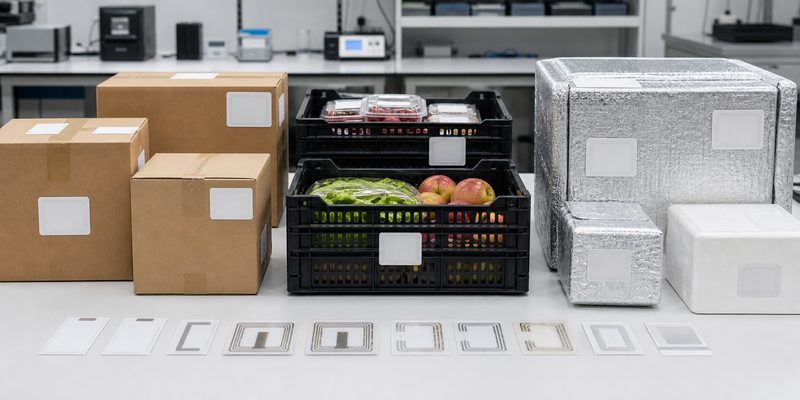
RFID tags for food traceability work best when the tag is selected around the package, the read point, and the data workflow, not around the tag name alone. A label that reads well on a dry corrugated carton may perform differently on a wet plastic crate, a foil-lined insulated box, or a tray of liquid-rich products. Before ordering at scale, buyers should define the traceable unit, confirm the packaging surface, and test samples in the same cold room, dock door, or conveyor environment where the tags will be used.

For most food logistics projects, passive UHF RFID labels are the first option to evaluate because they support fast carton, case, tote, and pallet identification. HF or NFC tags may still fit short-range consumer interaction, authentication, or item-level scenarios. The right choice depends on whether the project needs fast inventory capture, chain-of-custody visibility, consumer engagement, or durable asset tracking for reusable crates.

Which RFID Tag Fits Food Traceability?

Start with a custom RFID sticker or label for dry cartons and outer packaging. Move to synthetic face stock, stronger adhesive, or a sealed tag when moisture, condensation, abrasion, or repeated handling is expected. Use RFID inlays when a converter needs to build the antenna and chip into a printed label, smart package, or custom label format.

If the project tracks cases, totes, and pallets through receiving or dispatch, evaluate UHF RFID tags. If the project links consumers to product information by phone, NFC may be a better fit. If the tag must stay on a reusable plastic crate, cold box, or metal rack, ask whether a more durable waterproof RFID tag or asset tag is needed instead of a disposable paper label.

RFID

Define the Traceable Unit Before Choosing the Label

Food traceability can happen at several levels: item, inner pack, case, tote, pallet, or returnable transport item. Do not choose the smallest tag by default. A carton-level label may be enough for warehouse receiving, while item-level tagging can add unnecessary cost and complexity if the system only needs lot movement and dispatch confirmation.

Before requesting samples, document what the software will identify: EPC number, SKU, lot, batch, production date, shelf-life status, shipment ID, or a reusable container ID. In many deployments, the RFID tag stores a unique identifier while the detailed food traceability data lives in the backend system. That keeps tag encoding simple and makes data corrections easier than writing every attribute onto tag memory.

Packaging Surface Changes RFID Performance

RFID performance is strongly affected by the surface behind the label. Corrugated cardboard is usually easier than foil-lined insulation, metalized film, liquid-heavy products, or wet plastic. Food packaging also introduces condensation, frost, grease, cleaning chemicals, and rough handling. These conditions may damage the face stock, weaken adhesive, or change how the antenna couples with the package.

For carton labels, confirm the label size, antenna orientation, adhesive, and printer compatibility. For plastic crates, check whether the label will be disposable or must survive many wash and return cycles. For insulated boxes or foil surfaces, test actual samples because the reflective material can reduce read consistency. For liquid-rich products, avoid assuming that a label proven on dry goods will work without adjustment.

Food Traceability RFID Tag Options

Tag option Best fit What to confirm before ordering
Paper UHF RFID label Dry cartons, cases, pallet labels, general warehouse flow Printer method, adhesive, read distance target, EPC encoding rule
Synthetic RFID label Chilled cartons, damp handling, plastic packaging, condensation risk Face stock, adhesive, moisture exposure, freezer or refrigeration test
Custom RFID inlay Smart packaging, label converting, brand-specific label sizes Antenna size, chip, converting process, placement tolerance
Durable asset RFID tag Reusable crates, totes, cold boxes, racks, food service containers Mounting method, washing process, impact risk, read points
NFC tag Consumer product information, authentication, digital packaging Phone compatibility, surface material, NDEF data, lock or rewrite plan

Cold Chain Projects Need Material Testing, Not Just Chip Selection

Cold chain RFID labels should be tested through the same temperature, humidity, and handling pattern expected in the project. A sample that reads on a room-temperature carton may curl, lose adhesion, or scan inconsistently after refrigeration or condensation. The practical test is simple: apply labels to real packages, cool them under normal conditions, move them through the actual read point, and record missed reads by label position and package type.

When the package is exposed to water, ice, cleaning, or repeated handling, ask for material samples before choosing the chip. In many projects, upgrading from paper to synthetic construction solves more problems than changing memory size. If the project also needs temperature history, that becomes a separate sensing requirement and should be confirmed with the system provider before assuming a standard passive RFID label can record environmental data.

Handheld

Plan Encoding and Numbering Early

Food traceability fails when the physical label and the database do not match. Decide how each RFID label will be encoded before production: EPC format, serial number range, SKU mapping, lot relationship, or integration file. If printed human-readable numbers, barcodes, or QR codes are used alongside RFID, the printed value and encoded value must be mapped and checked together.

For higher-volume runs, prepare a packing and verification file. The file should show which EPCs are assigned to which roll, box, carton batch, or shipment. This helps receiving teams diagnose problems quickly if a label roll is damaged, a number range is duplicated, or a packing sequence does not match the software import.

Where to Place RFID Labels on Food Packaging

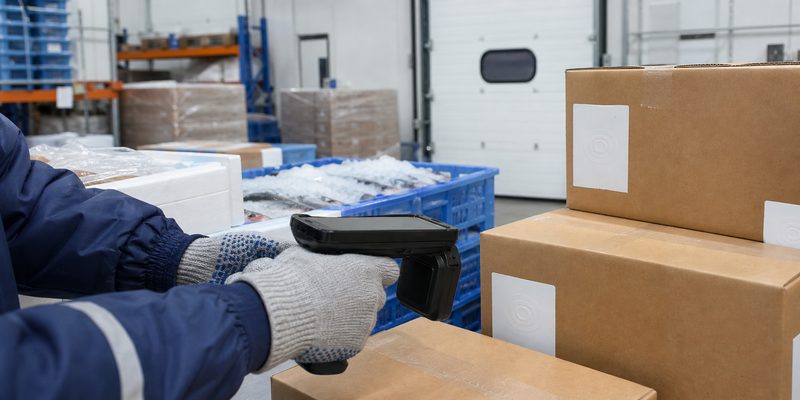
Label placement should be chosen with the read point in mind. A handheld inventory count, a conveyor antenna, and a dock-door portal all energize the tag from different angles. Place test labels on multiple sides of the carton or crate, then compare read consistency while the package is stacked, wrapped, chilled, or moved at normal speed.

Avoid placing the RFID label across folds, crushed corners, wet seams, foil edges, or areas that workers handle heavily. If the package is shrink-wrapped, test whether the wrap changes the label angle or traps moisture. For reusable crates, confirm whether the tag should be recessed, riveted, embedded, or protected by a label window.

Sample Test Checklist Before Bulk Production

  • Confirm the traceable unit: item, case, tote, pallet, or reusable asset.
  • List the packaging surfaces: cardboard, plastic, foam, foil, glass, or metalized film.
  • Choose the read method: handheld, desktop reader, conveyor, shelf, or dock-door portal.
  • Test labels after refrigeration, condensation, stacking, and normal handling.
  • Check EPC encoding, printed number mapping, and software import files.
  • Compare label placement options using the real reader and antenna setup.
  • Review whether disposable labels or durable reusable tags fit the cost model.
  • Keep failed samples and read logs so the supplier can adjust antenna size, material, or adhesive.
RFID

Common Mistakes in Food RFID Label Sourcing

The first mistake is treating food traceability as a software-only project. Software matters, but poor tag placement or weak adhesive can break the workflow before the data reaches the system. The second mistake is copying a label from a different product category. A label used on dry apparel packaging may not be suitable for chilled seafood cartons, plastic produce crates, or insulated delivery boxes.

The third mistake is skipping printed-number control. Warehouse and quality teams still need a visible fallback when a reader, handheld, or network connection is unavailable. The fourth mistake is overloading tag memory. In many food applications, a clean unique ID plus reliable backend data is easier to manage than writing too much changing information onto the tag.

How WXR Can Support Food Traceability Tag Projects

WXR can help buyers compare RFID labels, inlays, NFC tags, waterproof tags, and reusable asset tag formats for food packaging and cold-chain workflows. Share your packaging material, target read point, frequency preference, label size, printing method, encoding rule, and sample test conditions. For projects that involve warehouse visibility, reusable containers, or carton-level tracking, WXR can also help compare asset tracking RFID tags and related label options.

If you are still defining the system, start with the basics in RFID asset tracking and compare RFID with barcode workflows in RFID vs barcode. When you are ready to test samples, contact WXR with your package photos, read-point design, and encoding requirements.

FAQ

Are RFID tags safe to use on food packaging?

RFID tags are commonly applied to outer packaging, cartons, crates, and logistics units rather than directly to food. Buyers should confirm material, adhesive, placement, and any market-specific packaging requirements before rollout.

Should food traceability use UHF RFID or NFC?

Use UHF RFID when the goal is fast warehouse, case, tote, or pallet identification. Use NFC when phone interaction, consumer engagement, or short-range authentication is the main requirement.

Can RFID labels work in refrigerated or frozen logistics?

They can, but the label material, adhesive, package surface, and read point must be tested under real cold-chain conditions. Do not rely only on room-temperature sample reads.

What data should be encoded into food traceability RFID tags?

Most projects encode a unique ID such as an EPC and keep detailed product, lot, shipment, or status data in the backend system. This should be agreed before label production.

Do RFID labels replace barcodes in food logistics?

Not always. Many projects use RFID for fast non-line-of-sight capture and keep barcodes or printed numbers as a visible fallback for exception handling.

Schema Recommendation

Use Article schema for the main post and FAQPage schema for the visible FAQ section.

Facts and Assumptions to Verify

This article assumes a passive RFID label or tag project for food packaging, logistics, or reusable container tracking. Confirm local food-contact packaging rules, adhesive requirements, temperature exposure, reader setup, software data model, and any customer compliance requirements before mass production.

RFID Sticker Materials and Adhesive Labels: Buyer Checklist

Quick answer: the best RFID sticker is not chosen by size alone. Buyers should match the face material, inlay, adhesive, mounting surface, frequency, print method, and test environment before ordering. A paper UHF logistics label may work well on cartons, while plastic containers, glass, curved products, outdoor assets, or metal surfaces often need a different adhesive, antenna format, or anti-metal construction.

This checklist is for distributors, system integrators, warehouse teams, and brand owners comparing RFID stickers and labels for real projects. It focuses on quote preparation and sample testing, not generic RFID theory. If you are still comparing basic frequency options, read WXR’s guide to LF, HF, and UHF RFID before locking the label structure.

Layered RFID adhesive label showing face material inlay adhesive and liner

What Is Inside an RFID Sticker?

An RFID sticker usually combines a printable face layer, an RFID inlay, adhesive, and a release liner. The inlay contains the chip and antenna. The face layer handles printing and surface durability. The adhesive decides whether the label stays attached during packing, shipping, cleaning, handling, or storage. These parts have to work together, because a strong chip cannot compensate for the wrong antenna position or an adhesive that lifts from the asset.

For many packaging and inventory projects, the starting point is a wet inlay or converted label from the RFID inlay family. For finished labels, WXR can help compare paper, PET, PVC, synthetic paper, printable NFC labels, UHF logistics labels, and special constructions such as flexible anti-metal labels. The right structure depends on the surface and reader setup more than on the product photo.

RFID Sticker Material Selection Table

Project conditionLabel direction to considerWhat to confirm before ordering
Cartons, paper packaging, shipping labelsPaper or synthetic UHF RFID labelPrinter type, label size, roll direction, read zone, EPC encoding
Plastic bins, reusable totes, curved bottlesPET, PVC, or flexible label with stronger adhesiveSurface energy, curve radius, cleaning method, edge lifting risk
Metal tools, racks, IT equipment, machineryFlexible anti-metal label or hard on-metal tagSpacer thickness, mounting method, read distance target, impact risk
Phone interaction, packaging authentication, marketingHF/NFC sticker, often NTAG or MIFARE basedPhone compatibility, memory size, NDEF content, lock or rewrite policy
Outdoor or humid storageWater-resistant face stock and adhesiveUV exposure, condensation, cleaning chemicals, temperature range to test

Start With the Surface, Not the Chip

A common RFQ mistake is asking for a chip model first and discussing the asset later. The surface changes both adhesion and RF performance. Cardboard is forgiving. Low-energy plastics can reject ordinary adhesives. Curved glass can pull label edges upward. Liquids near the tag can detune some UHF labels. Metal can block or reflect RF energy unless the label is designed for on-metal use. For metal assets, compare options under anti-metal RFID tags instead of applying a normal logistics label and hoping the reader power solves it.

Prepare surface samples before you request pricing. Include the real carton coating, tote plastic, bottle curve, metal finish, paint layer, or asset housing. If the item will be cleaned, frozen, handled with gloves, stacked, or exposed to sunlight, say that early. The supplier can then recommend a face material and adhesive that matches the job instead of quoting the cheapest standard roll.

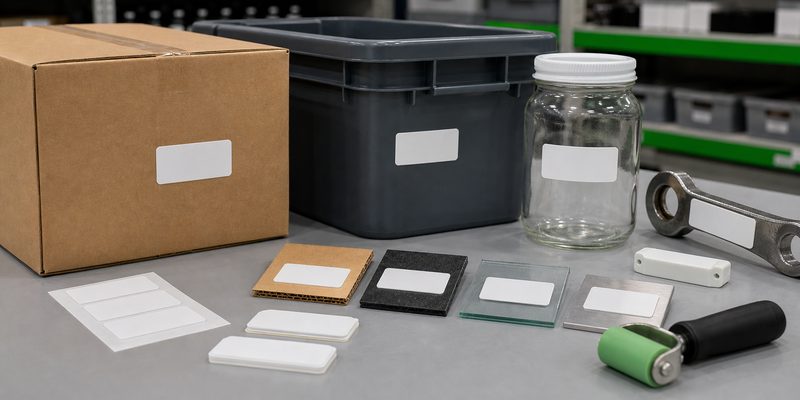
RFID sticker labels tested on cardboard plastic glass and metal samples

Choose Frequency Around the Workflow

HF and NFC labels are usually selected for close-range interaction, access, product information, and smartphone reading. UHF labels are usually selected for logistics, apparel, warehouse inventory, and longer-range scanning. If the project needs bulk reading at a dock door or conveyor, look at 860-960MHz UHF RFID tags. If the label is meant to open a URL on a phone or support customer interaction, review NFC tags and confirm the memory and lock requirements.

Do not treat read range as a fixed catalog value. It depends on the reader, antenna, tag orientation, surface, nearby material, radio regulations, and software filtering. For many projects, the practical target is not maximum range; it is stable reads at the real choke point without duplicate or missed events.

Placement and Application Checklist

  • Clean the surface and let it dry before applying samples.
  • Keep the label away from heavy folds, box seams, sharp curves, and crush zones.
  • For UHF labels, test orientation against the reader antenna instead of assuming any angle works.
  • Avoid placing ordinary labels directly on metal, liquid-filled areas, or dense foil packaging unless the label is designed for that surface.
  • Record the exact placement location so operators can repeat it during rollout.
  • After application, check edge lift, wrinkle formation, and label damage after normal handling.

For printed labels, confirm whether the artwork leaves enough space around the chip bump and antenna area. Heavy ink coverage, cutting pressure, lamination heat, or aggressive bending can damage the inlay. If the label will be printed and encoded in the same workflow, confirm printer compatibility, roll core size, winding direction, pitch, and rejected-label handling.

How to Test RFID Sticker Samples Before Bulk Orders

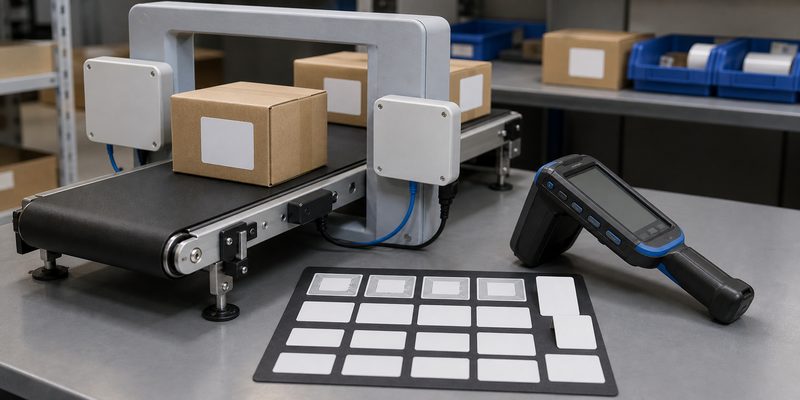
RFID label sample testing at a reader gate with cartons and handheld reader

Sample testing should include both physical adhesion and read performance. Apply labels to real items, wait long enough for the adhesive to settle, and then test the same movement that operators will use: handheld scan, shelf scan, tunnel reader, conveyor gate, doorway, or phone tap. For UHF projects, test several orientations and multiple items together. For NFC projects, test common iPhone and Android positions, not only a desktop NFC reader.

Track failures by cause. Did the label peel off, wrinkle, detune near the surface, collide with other tags, or read only when the operator touches a perfect spot? Each failure points to a different fix. You may need a different antenna size, a stronger adhesive, a flexible anti-metal construction, a new placement location, or a reader antenna adjustment. That is why samples are more useful than a catalog read-range number.

What to Send WXR for a Faster Quote

For a practical quote, send the application, item material, label size, frequency or reader system, chip preference if known, print design, encoding data, operating environment, sample quantity, and the read point you want to test. Photos of the asset and the proposed label position are especially helpful. If you are unsure which RFID sticker material fits, contact WXR with the surface and workflow details, and the team can suggest label structures for sample testing before mass production.

FAQ

Are paper RFID stickers durable enough?

Paper RFID stickers can be a good fit for dry cartons, retail hang tags, and short-to-medium logistics workflows. They are not the first choice for heavy abrasion, frequent washing, outdoor exposure, or curved reusable assets unless the full label structure is designed and tested for that environment.

Can normal RFID stickers work on metal?

Usually not reliably. Metal can detune or block ordinary RFID labels, especially UHF labels. Use an anti-metal label or tag and test it on the real metal surface with the actual reader setup.

Which is better for packaging, NFC or UHF RFID stickers?

Use NFC when the user should tap the package with a phone at close range. Use UHF when the operation needs inventory, logistics, or bulk scanning. Some packaging projects use both, but the cost, space, and data plan should be justified.

What should be tested before ordering custom RFID labels?

Test adhesion, edge lift, printing, encoding, read range, orientation, item stacking, nearby materials, cleaning or handling conditions, and software event filtering. A small sample test can prevent expensive label failure after rollout.

Fact and assumption note: material durability, adhesive strength, read range, and compatibility depend on the exact label construction, reader, surface, and environment. Confirm these with samples before bulk production.

RFID Baggage Tags for Aviation: Label, Inlay, and Deployment Checklist

RFID baggage tags are used when an airport, airline, integrator, or baggage-handling team needs a better way to identify checked luggage through multiple handoff points. The tag is not only a printed label. It is a small RFID system decision: label stock, UHF inlay, chip memory, encoding workflow, printer compatibility, conveyor read points, and real-bag testing all have to work together.

The practical question for buyers is not “Does RFID work for baggage?” It is “Which baggage tag format can survive our handling process, read reliably in our lanes, and fit our software workflow without disrupting check-in?” This checklist explains what to specify before asking for samples or a quote.

RFID baggage tag samples for aviation luggage tracking

What Is an RFID Baggage Tag?

An RFID baggage tag is usually a luggage label or reusable luggage credential with an embedded RFID inlay. Most aviation baggage applications use passive UHF RFID because UHF is suitable for conveyor read zones, portal reads, and automated handling points where the bag may not face the scanner perfectly. A barcode may still be printed on the label for visual backup, but RFID can add a radio-readable identity that does not require the same direct line of sight.

For buyers, the tag should be considered together with the baggage-handling system. A good label in a poor read-point layout will still create missed reads. A strong reader setup cannot fully compensate for a label that peels, folds across the antenna, or uses an inlay that is too small for the required orientation and read zone.

Where RFID Fits in an Aviation Baggage Workflow

RFID baggage identification is most useful at points where bags move quickly, change direction, or pass through automated routing. Typical read points include check-in induction, conveyor junctions, security screening handoffs, make-up areas, loading confirmation, transfer baggage, and arrival handling. The tag ID must connect to the baggage record in the airline, airport, or integrator’s software; the RFID tag alone does not create traceability unless the data workflow is defined.

This is why early specification should include both physical and data questions. What is printed? What is encoded? Which system writes the tag? Which reader confirms the bag? What happens when a tag is damaged, unreadable, duplicated, or attached in the wrong position?

Choose the Right RFID Baggage Tag Format

Start with the way the tag will be used. Temporary checked-bag labels, reusable luggage tags, transfer labels, and internal airport asset tags have different durability and cost requirements.

RFID baggage label formats with inlay and reusable luggage tag samples
Format Best fit What to confirm before ordering
Disposable RFID baggage label Check-in and transfer baggage where the tag is used for one trip Thermal print compatibility, adhesive strength, inlay placement, label fold path, and roll format
RFID wet inlay for converting Label converters or integrators producing custom baggage labels Antenna size, chip model, pitch, liner, adhesive, converting process, and encoding method
Reusable luggage RFID tag Closed-loop baggage, staff bags, VIP luggage, or equipment cases Material, attachment method, chip memory, environmental exposure, and replacement process
Hard or special-purpose RFID tag Equipment cases, airport containers, or baggage carts rather than passenger bags Mounting surface, metal/liquid exposure, impact, cleaning, and read distance target

WXR can support custom RFID stickers and labels, RFID inlays, and UHF RFID tags for projects where size, material, chip selection, printing, and encoding need to match a real process.

Key Specifications to Send Your RFID Supplier

A useful RFQ should be more specific than “RFID baggage tags.” Send the supplier enough context to avoid a generic sample that looks good on a desk but fails on a moving conveyor.

  • Application: passenger baggage, transfer baggage, internal airport assets, reusable bags, or equipment cases.
  • Frequency: usually UHF for conveyor and bulk-reading workflows; confirm regional frequency requirements and reader system compatibility.
  • Chip and memory: EPC length, User memory need, TID use, locking rules, and whether encoding happens before delivery or at check-in.
  • Label construction: paper, synthetic film, adhesive, liner, roll size, printer compatibility, and where the inlay sits inside the label.
  • Attachment and folding: how the label wraps around the bag handle and whether the fold line crosses the antenna.
  • Environment: abrasion, humidity, rain exposure, temperature changes, conveyor contact, and handling pressure.
  • Read points: handheld, portal, tunnel, conveyor antenna, chute, loading area, or mixed reader setup.
  • Data workflow: who writes the EPC, how duplicate IDs are prevented, and how exceptions are handled.

Read-Point Design Matters as Much as the Tag

RFID read performance depends on tag antenna design, reader power, antenna placement, bag orientation, nearby metal, liquid contents, and motion speed. Baggage is especially variable: soft bags, hard-shell cases, wrapped luggage, wet surfaces, and handles can all change the way a tag presents to the reader.

Airport baggage conveyor RFID read point with blank luggage tags

For that reason, do not select the smallest or cheapest inlay only from a datasheet. Test several inlay sizes and label positions in the actual read zone. If the reader is mounted under or beside a conveyor, test bags that are upright, flat, angled, and overlapping. If the project includes transfer bags or high-speed sortation, test at the expected conveyor speed rather than on a static table.

For longer read zones, compare long-range RFID tag options carefully, but keep expectations realistic. Longer range is useful only when the system can still identify the correct bag and avoid unwanted reads from nearby lanes or stacked luggage.

Sample Testing Checklist Before Bulk Production

Sample testing should reproduce the way baggage moves, bends, and gets handled. A simple desktop scan is not enough for aviation-style baggage workflows.

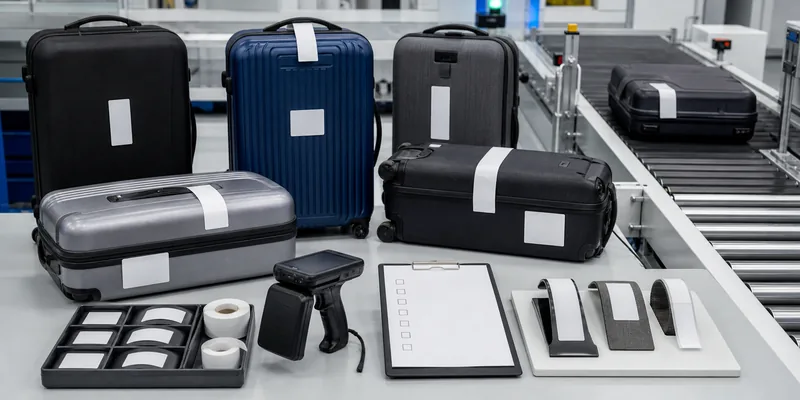
RFID baggage tag sample testing setup with suitcases and reader
  1. Print and encode sample labels using the intended printer, encoder, and data format.
  2. Attach labels to real luggage handles and surfaces, including hard-shell and soft bags.
  3. Test several fold positions so the antenna is not damaged or detuned by the label wrap.
  4. Run bags through the planned read points at expected speed and spacing.
  5. Record missed reads, duplicate reads, wrong-lane reads, and any damaged labels.
  6. Check whether the barcode or human-readable backup remains usable after handling.
  7. Confirm that the EPC or encoded ID maps correctly to the baggage record in software.
  8. Repeat with wet, worn, overpacked, and irregular luggage if those conditions are common.

Common Mistakes to Avoid

The first mistake is treating the RFID inlay as a commodity. Inlay size, antenna tuning, chip sensitivity, and placement inside the label all affect performance. The second mistake is ignoring label mechanics. If the adhesive, liner, or fold path does not match the baggage process, read performance can decline even when the chip is suitable.

The third mistake is using read range as the only selection metric. Aviation baggage projects need controlled reads, not just maximum reads. A tag that reads too far may create cross-reads if antenna power and shielding are not tuned correctly. The fourth mistake is forgetting exception handling. Operators need a defined process for damaged labels, unreadable tags, duplicate EPCs, fallback barcodes, and manual reconciliation.

How WXR Can Support RFID Baggage Tag Projects

WXR manufactures custom RFID and NFC products for distributors, system integrators, and project buyers. For baggage-related RFID projects, WXR can help compare UHF inlays, adhesive label formats, reusable tag materials, printing requirements, serial or EPC encoding, and sample-testing plans. The best starting point is to share the application, label size, reader setup, printer model, encoding rules, expected environment, and sample quantity.

If your project is still at the design stage, review WXR’s guides on what RFID tags are and RFID asset tracking. For project quoting, contact WXR with baggage photos, read-point details, and label-format requirements so the team can recommend samples before mass production.

FAQ

Are RFID baggage tags the same as normal barcode baggage labels?

No. A normal baggage label may rely mainly on printed barcode and human-readable information. An RFID baggage tag includes an embedded RFID inlay so the tag can be read by compatible RFID readers. Many projects still keep printed information as a backup.

Which RFID frequency is usually used for baggage tracking?

UHF RFID is commonly considered for conveyor, portal, and multi-point baggage reads because it supports longer read zones than LF or HF. The correct choice still depends on reader infrastructure, regional frequency rules, and the actual handling process.

Can RFID baggage tags guarantee that bags will never be lost?

No. RFID can improve identification and event capture, but it does not replace good software, process control, exception handling, and operational training. Avoid any supplier claim that promises perfect baggage handling from the tag alone.

Should the RFID tag be pre-encoded before delivery?

It depends on the workflow. Some projects use pre-encoded EPCs or serials for controlled batches. Others encode at check-in or during label printing. Confirm the data format, uniqueness rules, and verification step before production.

What should I test before ordering RFID baggage labels in bulk?

Test printer compatibility, encoding, label folding, adhesive, real luggage placement, conveyor speed, reader antenna layout, read accuracy, damaged-label handling, and software mapping. Use real baggage samples rather than only flat-label bench tests.

Ask For A Quick Quote

Your inquiry will be replied within 24 hours! Please pay attention to the email with the suffix “@tag-rfid.com”. If not received, please check your spam email.