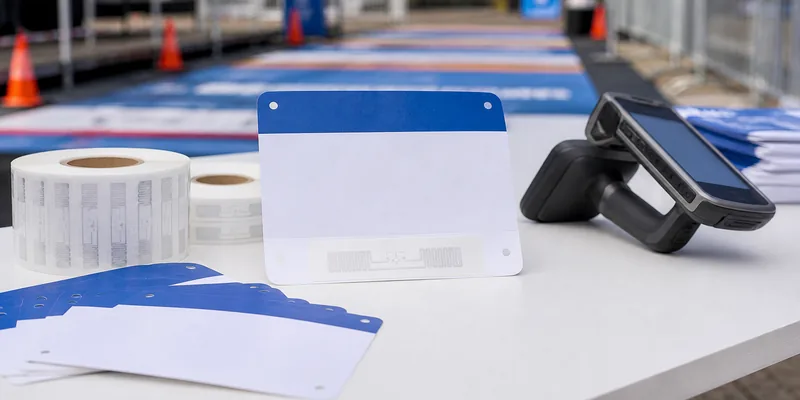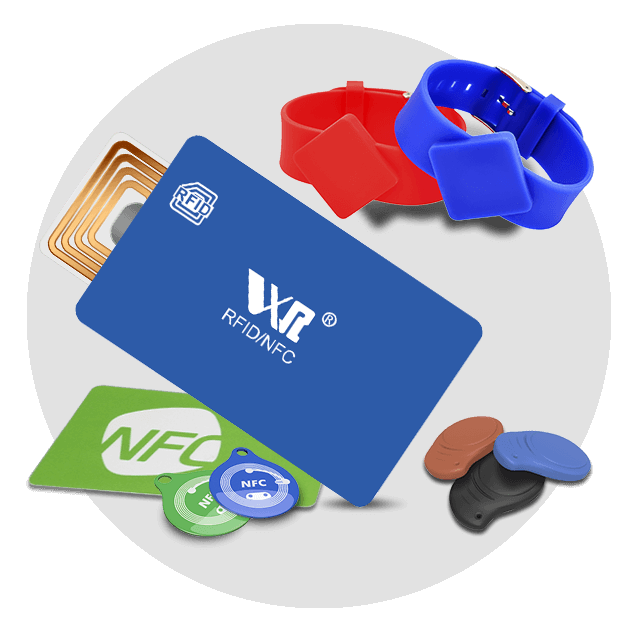
RFID baggage tags are used when an airport, airline, integrator, or baggage-handling team needs a better way to identify checked luggage through multiple handoff points. The tag is not only a printed label. It is a small RFID system decision: label stock, UHF inlay, chip memory, encoding workflow, printer compatibility, conveyor read points, and real-bag testing all have to work together.
The practical question for buyers is not “Does RFID work for baggage?” It is “Which baggage tag format can survive our handling process, read reliably in our lanes, and fit our software workflow without disrupting check-in?” This checklist explains what to specify before asking for samples or a quote.
What Is an RFID Baggage Tag?
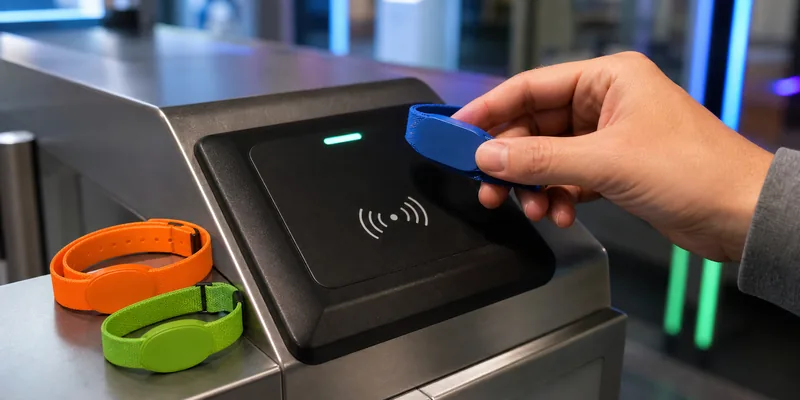
An RFID baggage tag is usually a luggage label or reusable luggage credential with an embedded RFID inlay. Most aviation baggage applications use passive UHF RFID because UHF is suitable for conveyor read zones, portal reads, and automated handling points where the bag may not face the scanner perfectly. A barcode may still be printed on the label for visual backup, but RFID can add a radio-readable identity that does not require the same direct line of sight.
For buyers, the tag should be considered together with the baggage-handling system. A good label in a poor read-point layout will still create missed reads. A strong reader setup cannot fully compensate for a label that peels, folds across the antenna, or uses an inlay that is too small for the required orientation and read zone.
Where RFID Fits in an Aviation Baggage Workflow
RFID baggage identification is most useful at points where bags move quickly, change direction, or pass through automated routing. Typical read points include check-in induction, conveyor junctions, security screening handoffs, make-up areas, loading confirmation, transfer baggage, and arrival handling. The tag ID must connect to the baggage record in the airline, airport, or integrator’s software; the RFID tag alone does not create traceability unless the data workflow is defined.
This is why early specification should include both physical and data questions. What is printed? What is encoded? Which system writes the tag? Which reader confirms the bag? What happens when a tag is damaged, unreadable, duplicated, or attached in the wrong position?
Choose the Right RFID Baggage Tag Format
Start with the way the tag will be used. Temporary checked-bag labels, reusable luggage tags, transfer labels, and internal airport asset tags have different durability and cost requirements.
| Format | Best fit | What to confirm before ordering |
|---|---|---|
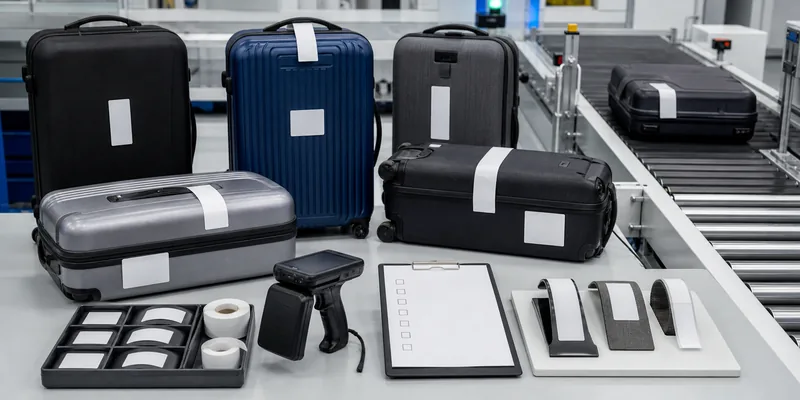
| Disposable RFID baggage label | Check-in and transfer baggage where the tag is used for one trip | Thermal print compatibility, adhesive strength, inlay placement, label fold path, and roll format |
| RFID wet inlay for converting | Label converters or integrators producing custom baggage labels | Antenna size, chip model, pitch, liner, adhesive, converting process, and encoding method |
| Reusable luggage RFID tag | Closed-loop baggage, staff bags, VIP luggage, or equipment cases | Material, attachment method, chip memory, environmental exposure, and replacement process |
| Hard or special-purpose RFID tag | Equipment cases, airport containers, or baggage carts rather than passenger bags | Mounting surface, metal/liquid exposure, impact, cleaning, and read distance target |
WXR can support custom RFID stickers and labels, RFID inlays, and UHF RFID tags for projects where size, material, chip selection, printing, and encoding need to match a real process.
Key Specifications to Send Your RFID Supplier
A useful RFQ should be more specific than “RFID baggage tags.” Send the supplier enough context to avoid a generic sample that looks good on a desk but fails on a moving conveyor.
- Application: passenger baggage, transfer baggage, internal airport assets, reusable bags, or equipment cases.
- Frequency: usually UHF for conveyor and bulk-reading workflows; confirm regional frequency requirements and reader system compatibility.
- Chip and memory: EPC length, User memory need, TID use, locking rules, and whether encoding happens before delivery or at check-in.
- Label construction: paper, synthetic film, adhesive, liner, roll size, printer compatibility, and where the inlay sits inside the label.
- Attachment and folding: how the label wraps around the bag handle and whether the fold line crosses the antenna.
- Environment: abrasion, humidity, rain exposure, temperature changes, conveyor contact, and handling pressure.
- Read points: handheld, portal, tunnel, conveyor antenna, chute, loading area, or mixed reader setup.
- Data workflow: who writes the EPC, how duplicate IDs are prevented, and how exceptions are handled.
Read-Point Design Matters as Much as the Tag
RFID read performance depends on tag antenna design, reader power, antenna placement, bag orientation, nearby metal, liquid contents, and motion speed. Baggage is especially variable: soft bags, hard-shell cases, wrapped luggage, wet surfaces, and handles can all change the way a tag presents to the reader.
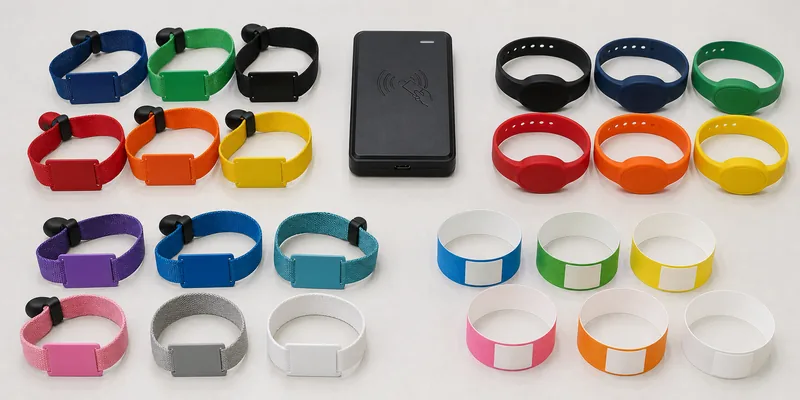
For that reason, do not select the smallest or cheapest inlay only from a datasheet. Test several inlay sizes and label positions in the actual read zone. If the reader is mounted under or beside a conveyor, test bags that are upright, flat, angled, and overlapping. If the project includes transfer bags or high-speed sortation, test at the expected conveyor speed rather than on a static table.
For longer read zones, compare long-range RFID tag options carefully, but keep expectations realistic. Longer range is useful only when the system can still identify the correct bag and avoid unwanted reads from nearby lanes or stacked luggage.
Sample Testing Checklist Before Bulk Production
Sample testing should reproduce the way baggage moves, bends, and gets handled. A simple desktop scan is not enough for aviation-style baggage workflows.
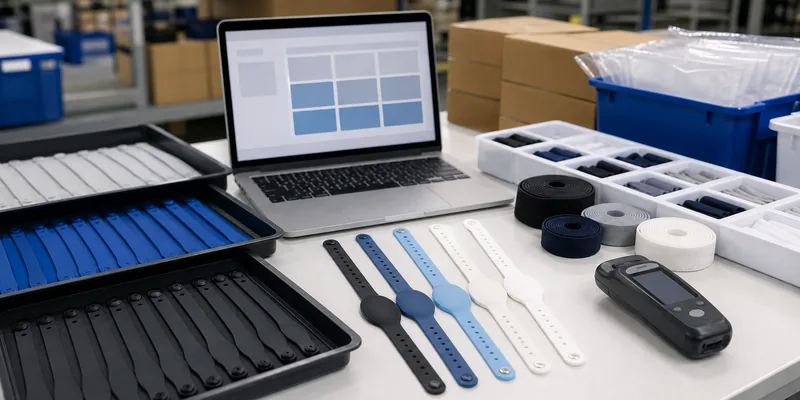
- Print and encode sample labels using the intended printer, encoder, and data format.
- Attach labels to real luggage handles and surfaces, including hard-shell and soft bags.
- Test several fold positions so the antenna is not damaged or detuned by the label wrap.
- Run bags through the planned read points at expected speed and spacing.
- Record missed reads, duplicate reads, wrong-lane reads, and any damaged labels.
- Check whether the barcode or human-readable backup remains usable after handling.
- Confirm that the EPC or encoded ID maps correctly to the baggage record in software.
- Repeat with wet, worn, overpacked, and irregular luggage if those conditions are common.
Common Mistakes to Avoid
The first mistake is treating the RFID inlay as a commodity. Inlay size, antenna tuning, chip sensitivity, and placement inside the label all affect performance. The second mistake is ignoring label mechanics. If the adhesive, liner, or fold path does not match the baggage process, read performance can decline even when the chip is suitable.
The third mistake is using read range as the only selection metric. Aviation baggage projects need controlled reads, not just maximum reads. A tag that reads too far may create cross-reads if antenna power and shielding are not tuned correctly. The fourth mistake is forgetting exception handling. Operators need a defined process for damaged labels, unreadable tags, duplicate EPCs, fallback barcodes, and manual reconciliation.
How WXR Can Support RFID Baggage Tag Projects
WXR manufactures custom RFID and NFC products for distributors, system integrators, and project buyers. For baggage-related RFID projects, WXR can help compare UHF inlays, adhesive label formats, reusable tag materials, printing requirements, serial or EPC encoding, and sample-testing plans. The best starting point is to share the application, label size, reader setup, printer model, encoding rules, expected environment, and sample quantity.
If your project is still at the design stage, review WXR’s guides on what RFID tags are and RFID asset tracking. For project quoting, contact WXR with baggage photos, read-point details, and label-format requirements so the team can recommend samples before mass production.
FAQ
No. A normal baggage label may rely mainly on printed barcode and human-readable information. An RFID baggage tag includes an embedded RFID inlay so the tag can be read by compatible RFID readers. Many projects still keep printed information as a backup.
Which RFID frequency is usually used for baggage tracking?
UHF RFID is commonly considered for conveyor, portal, and multi-point baggage reads because it supports longer read zones than LF or HF. The correct choice still depends on reader infrastructure, regional frequency rules, and the actual handling process.
No. RFID can improve identification and event capture, but it does not replace good software, process control, exception handling, and operational training. Avoid any supplier claim that promises perfect baggage handling from the tag alone.
Should the RFID tag be pre-encoded before delivery?
It depends on the workflow. Some projects use pre-encoded EPCs or serials for controlled batches. Others encode at check-in or during label printing. Confirm the data format, uniqueness rules, and verification step before production.
What should I test before ordering RFID baggage labels in bulk?
Test printer compatibility, encoding, label folding, adhesive, real luggage placement, conveyor speed, reader antenna layout, read accuracy, damaged-label handling, and software mapping. Use real baggage samples rather than only flat-label bench tests.