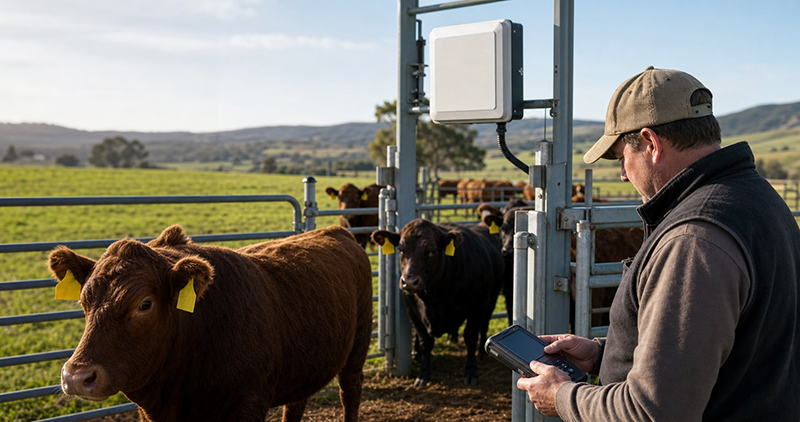
RFID is used in cattle tracking by giving each animal a unique electronic ID, usually through an RFID ear tag. When cattle pass a fixed reader at a chute, gate, scale, or loading point, or when a ranch worker scans the tag with a handheld reader, the system captures the tag number and links it to the animal’s digital record.
That record can include origin, age, breed, sex, vaccination history, treatments, weight, breeding events, ownership changes, and movement history. RFID does not usually track a cow’s live GPS location by itself. Instead, it confirms which animal was seen at a specific read point and when.
What an RFID Cattle Tracking System Includes
Most cattle RFID systems have four basic parts:
| Component | Role in cattle tracking |
|---|---|
| RFID ear tag or animal tag | Stores a unique electronic ID assigned to one animal |
| RFID reader | Reads the tag through a handheld wand, panel reader, gate reader, or scale setup |
| Antenna and read point | Defines where the animal is identified, such as a chute, pen gate, or loading dock |
| Herd software or database | Connects the RFID number to records, events, compliance documents, and reports |
For animal identification, low-frequency RFID systems based on ISO 11784 and ISO 11785 are widely used in many livestock programs. Some projects may evaluate UHF RFID for longer read zones, but buyers should confirm reader compatibility, regulations, and the real farm environment before rollout.
How RFID Cattle Tracking Works Step by Step
- Tag the animal. A durable RFID ear tag is applied to the animal and paired with a visual number, management number, or official identification number.
- Register the tag ID. The RFID number is linked to the animal profile in herd management software.
- Read the tag at key events. Readers identify cattle during weighing, treatment, breeding, pen movement, sale, transport, or receiving.
- Record the event automatically. The software updates the animal’s file with the date, location, action, operator, and any related data.
- Use the data for decisions. Managers can sort animals, verify treatment, review weight gain, prepare movement records, investigate disease exposure, or check inventory.
The main value is not the tag alone. The value comes from connecting automatic identification with useful records.
Where RFID Helps in Cattle Operations
Disease Traceability and Movement Records
RFID can make it faster to identify which cattle moved through a farm, market, feedlot, or transport point. In the United States, USDA APHIS updated animal disease traceability rules so certain cattle and bison moving interstate must use official identification that is both visually and electronically readable. The rule became effective on November 5, 2024, but the exact animal classes and local procedures should be checked before implementation.
Weighing, Sorting, and Feedlot Management
RFID readers can be integrated with scales, gates, and drafting systems. When an animal steps onto a scale, the reader captures the ID and the software assigns the weight to the correct record. This reduces manual entry errors and helps managers track gain, treatment groups, pen changes, and shipping readiness.
Health and Treatment Records
During vaccination, pregnancy checks, hoof care, or treatment, staff can scan the tag and update the animal’s record immediately. This helps connect each treatment to the correct animal instead of relying only on handwritten notes.
RFID Cattle Tags vs GPS Cattle Trackers
RFID cattle tags and GPS cattle trackers solve different problems.
| Feature | RFID cattle tracking | GPS cattle tracking |
|---|---|---|
| Main purpose | Identify an animal at a read point | Estimate live or periodic location |
| Power source | Often passive, powered by the reader signal | Usually battery powered |
| Common hardware | Ear tag, reader, antenna, software | GPS tag/collar, battery, network, cloud platform |
| Best for | ID, traceability, weighing, health records, compliance | Location monitoring, grazing behavior, theft alerts, remote pasture checks |
Many ranches use RFID first because it is practical for identification and records. GPS or sensor tags may be added when the need is live location or behavior monitoring.
How to Choose RFID Tags for Cattle Tracking
Before buying RFID tags for cattle, confirm these details:
- Frequency and standard: Check whether the workflow needs LF animal ID, UHF livestock tags, or another system.
- Compliance requirements: Confirm local rules, approved tag types, and number formats.
- Reader compatibility: Test the tag with your handheld reader, panel reader, scale head, or gate antenna.
- Durability: Tags should withstand outdoor exposure, animal movement, mud, moisture, and handling.
- Visual printing: Many cattle projects need both a readable printed number and an electronic ID.
- Software workflow: Decide whether the ID connects to health records, weights, inventory, or movement documents.
- Sample testing: Test tag retention, read reliability, animal flow, and database setup before bulk ordering.
WXR / TAG RFID supplies animal RFID tags and can help buyers compare ear tag formats, frequency options, printing, encoding, and sample plans. For background reading, see TAG RFID’s guide to what RFID is and its overview of LF, HF, and UHF RFID frequencies.
Implementation Checklist
- Map where cattle will be scanned: chute, scale, pen gate, transport, market, or treatment area.
- Define which events need automatic records.
- Choose tag type, frequency, number format, and visual printing.
- Test handheld and fixed reader performance with real animal flow.
- Train staff to scan, verify exceptions, and replace lost or damaged tags.
- Connect RFID reads to herd software instead of leaving IDs in a spreadsheet only.
- Review official identification rules before interstate movement or regulated sales.
Conclusion
RFID is used in cattle tracking to connect each animal with a reliable electronic identity. The tag identifies the animal, the reader captures the ID at important moments, and the software turns those reads into records for traceability, health management, weighing, sorting, and inventory control.
Planning a cattle RFID project? Share your application, frequency requirement, reader setup, tag format, printing needs, encoding needs, and testing environment with WXR / TAG RFID to request animal RFID tag samples.
FAQ
Is RFID cattle tracking the same as GPS tracking?
No. RFID identifies cattle when a tag is scanned by a reader. GPS tracking estimates location through a battery-powered device and network connection.
What information is stored on an RFID cattle tag?
The tag usually stores a unique ID. Detailed records such as weight, vaccination, treatment, breed, age, and ownership are normally stored in software and linked to that ID.
Do cattle RFID tags need line of sight?
RFID does not require visual line of sight like a barcode, but read performance still depends on reader type, antenna position, tag orientation, animal movement, distance, and interference.
Are RFID ear tags required for all cattle?
Rules depend on the country, region, animal class, and movement type. In the United States, current federal rules apply to certain cattle and bison moving interstate, not every animal in every situation.