RFID seal tags help logistics teams connect a physical seal with a digital identity. Instead of relying only on a printed number or a barcode, a container, trailer, tote, cage, meter box, or high-value shipment can be sealed and scanned as part of the handover record.
The important buying question is not simply whether the seal has an RFID chip. Buyers need to confirm the seal type, tamper-evident requirement, frequency, reader workflow, encoding file, printed numbering, packing order, and sample test conditions. A seal that works well at a desk may fail in a yard, cold room, metal container area, or busy receiving dock.
WXR can help project buyers compare RFID asset tracking tags, UHF RFID tags, waterproof tags, cable tie tags, and custom RFID tag formats for logistics and security workflows. Use this checklist before requesting RFID seal tag samples or a bulk quote.
What Is an RFID Seal Tag?
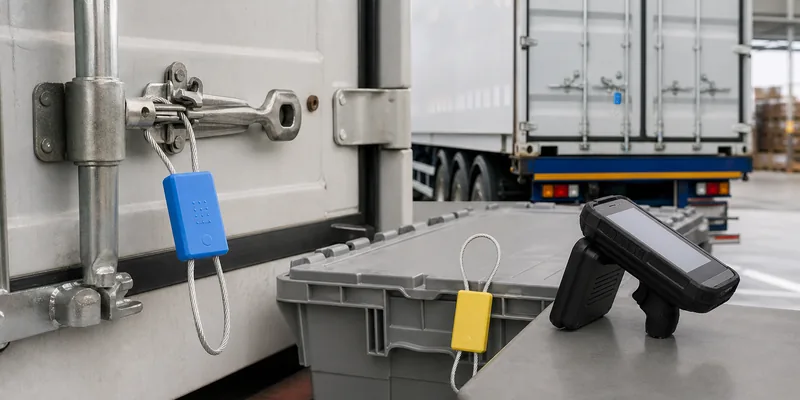
An RFID seal tag combines a physical sealing structure with an RFID chip and antenna. The physical part may be a cable seal, bolt seal, pull-tight plastic seal, tag tie, or enclosure attached to a container latch, trailer door, tote handle, meter box, pallet cage, or equipment cabinet. The RFID part gives the seal a readable electronic identity.
In many projects, the tag stores an EPC, UID, or other identifier. Shipment details, route data, custody records, inspection status, and exception notes usually belong in the logistics software or database, not directly on the tag. This keeps the tag simpler and reduces the risk of exposing sensitive shipment data if someone scans the seal outside the controlled system.
RFID seal tags make sense when a project needs both evidence of closure and faster digital verification. Typical use cases include container logistics, truck trailers, air cargo units, reusable transport items, locked totes, utility meters, telecom cabinets, warehouse cages, pharmaceutical shipments, electronics shipments, luxury goods, and controlled spare parts.
They are not a universal replacement for every RFID label. A standard RFID sticker or label may be better for cartons, documents, retail packaging, or normal item tracking. A rugged hard tag may be better for long-term equipment identification. An anti-metal RFID tag may be needed when the tag must sit directly on a metal surface for repeated scanning.
Use RFID seal tags when removal, opening, or substitution should be visible or auditable. The level of tamper evidence depends on the mechanical seal design, RFID circuit design, reader workflow, and software rules. Do not assume that every RFID seal can electronically report tampering. Some seals are visually tamper-evident only, while more advanced designs may support an electronic open or broken state.
Choose the Seal Type Before Choosing the Chip
The seal structure decides how the tag is installed and what kind of security role it can play. Start with the object being sealed, then choose the RFID frequency and chip.
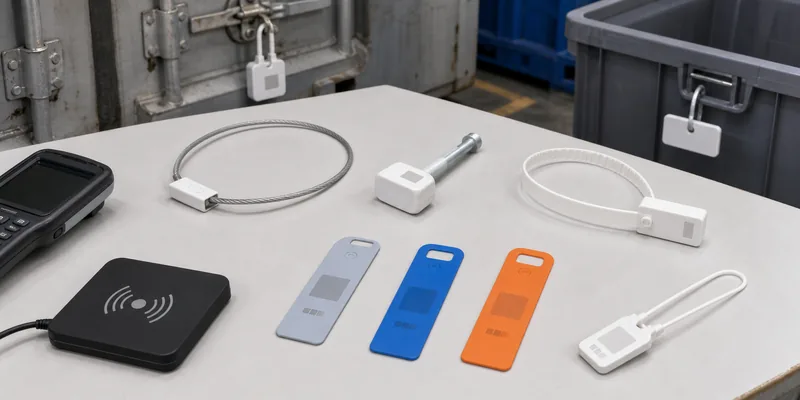
| Seal format | Common fit | What buyers should confirm |
|---|---|---|
| Cable RFID seal | Container doors, trailers, cages, valves, utility cabinets | Cable diameter, lock strength, one-time use, reader distance, outdoor exposure |
| Bolt RFID seal | Freight containers and higher-security logistics | Mechanical seal requirement, removal method, certification need, scanning position |
| Pull-tight RFID seal | Totes, bags, boxes, meter covers, small doors | Strap length, plastic grade, closure force, tamper visibility, color coding |
| Reusable RFID seal or tag tie | Rental assets, internal transfers, temporary custody checks | Release method, reuse count assumption, accountability rules, replacement plan |
If the shipment requires a recognized container-seal standard, confirm it in writing before ordering. ISO 17712 is a mechanical freight-container seal standard; an RFID feature by itself does not prove that a seal is suitable for a high-security container requirement.
Match UHF, HF, or NFC to the Read Workflow
Many logistics seal projects use UHF RFID because teams often want to scan seals at gates, docks, yards, warehouses, or vehicle checkpoints without line-of-sight barcode scanning. UHF is commonly used for passive RAIN RFID and EPC Gen2 style deployments, but local spectrum rules and reader settings vary by country or region.
Use UHF RFID tags when the project needs faster checkpoint reads, handheld audits, trailer scans, or multiple sealed assets in a zone. Use HF or NFC only when the workflow is close-range, phone-readable, or tied to a specific 13.56 MHz reader system. WXR’s guide to LF, HF, and UHF frequency differences is useful background when the reader system is not yet fixed.
Do not buy the seal before checking the reader. A UHF seal will not work with an NFC phone. An NFC seal will not support a UHF dock-door scan. The tag, reader, antenna, software filter, and operating region must match.
Define the Data Plan: EPC, TID, Printed Serial, and Software Match
RFID seal tags often fail operationally because the data plan is vague. The printed number, barcode, QR code, EPC, TID readback, packing label, and shipment record must point to the same seal. If the warehouse receives sealed totes in mixed bags with no serial order, staff may spend more time sorting tags than scanning them.
Prepare these details before production:
- Whether WXR should ship blank seals, printed seals, encoded seals, or printed-and-encoded seals.
- EPC format, number range, prefix, or customer-supplied encoding file.
- Whether fixed TID readback should be recorded for anti-duplicate checks. TID is factory-fixed; it should not be treated like writable EPC or User Memory.
- Printed serial number, barcode, QR code, logo, color, or destination marking.
- Whether User Memory is needed, and what should remain in the backend system instead.
- Packing order by route, site, container group, serial range, customer, or installation team.
- Readback report format for receiving inspection and software import.
For background on memory terms, see WXR’s explanation of TID memory in RFID. The safe procurement rule is simple: approve a small encoded sample set before mass production, then compare the supplier readback file with your import file.
Sample Testing Plan Before Bulk Order
A useful sample test copies the final workflow. It should include the same seal design, same reader, same installation position, same cargo or container material, same software rule, and the same operator movement expected during deployment.
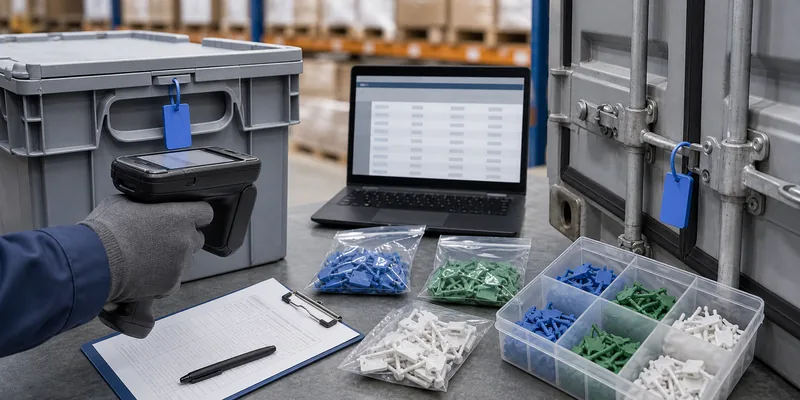
- Install samples on actual containers, trailer latches, totes, bags, cages, cabinets, or meters.
- Scan from the normal handheld position and from any fixed reader or gate location.
- Compare read performance with doors open, doors closed, stacked totes, crowded cages, and nearby metal.
- Check whether the seal rotates, loosens, breaks, scratches, freezes, or blocks normal handling.
- Verify printed serials, barcodes, QR codes, EPC values, and TID capture against one master file.
- Test the exception workflow: missing seal, duplicate ID, unreadable seal, cut seal, wrong route, or wrong packing group.
- Keep failed samples and record the failure reason so the supplier can adjust seal type, antenna, material, or packing method.
Do not approve a bulk order based on the longest open-air read. Real performance depends on reader power, antenna position, tag orientation, cable or bolt location, nearby metal, liquid, weather, tag density, regional settings, and software filtering.
Questions to Ask an RFID Seal Tag Supplier
Ask practical questions that affect field deployment:
- Is the seal one-time use, reusable, visually tamper-evident, or electronically tamper-detecting?
- Which frequency and chip match our readers and region?
- Can the seal be printed with serial numbers, barcodes, QR codes, color coding, or a logo?
- Can each seal be pre-encoded and supplied with a readback file?
- What seal length, cable diameter, strap type, or bolt format fits our application?
- What environmental conditions should be tested: outdoor yard, rain, cold chain, dust, cleaning, vibration, or rough handling?
- How will the finished seals be packed so the installation team can apply them in the correct order?
WXR can help compare RFID seal-style tags with waterproof RFID tags, asset tracking tags, anti-metal tags, labels, and custom RFID formats. Send the application, photos, reader model, frequency, seal type, material, printing, encoding file, quantity, and test environment before requesting samples.
Conclusion
RFID seal tags are most useful when a logistics workflow needs both physical closure and digital traceability. The right choice depends on the seal structure, frequency, reader setup, tamper-evidence requirement, data plan, printed numbering, packing order, and sample test results.
If you are planning container, trailer, tote, cage, meter, or high-value shipment tracking, contact WXR with your seal application and reader environment. WXR can help prepare sample options for comparison before mass production.
FAQ
They can overlap, but they are not always the same. Some RFID cable tie tags are used mainly for attachment and asset identification. RFID seal tags usually add a sealing or tamper-evident role, such as one-time locking, visible damage after removal, or an electronic status feature in some designs.
Many logistics and container seal projects use UHF RFID because it supports checkpoint and handheld reading. HF or NFC may fit close-range inspection or phone-readable workflows. The correct frequency depends on the reader system and operating process.
RFID seal tags can support tamper evidence and custody checks, but they do not prove security by themselves. The result depends on the mechanical seal, RFID design, inspection procedure, software records, and how exceptions are handled.
What should I send before requesting RFID seal tag samples?
Send photos of the sealing point, the object being sealed, reader model, frequency requirement, seal type, cable or strap length, environment, printing needs, encoding rule, quantity, and sample test plan.
WXR can support custom RFID tag production with chip selection, material and size options, logo or serial printing, QR/barcode printing, and data encoding depending on the selected design. Confirm artwork, data files, sample approval, and readback reporting before bulk production.