
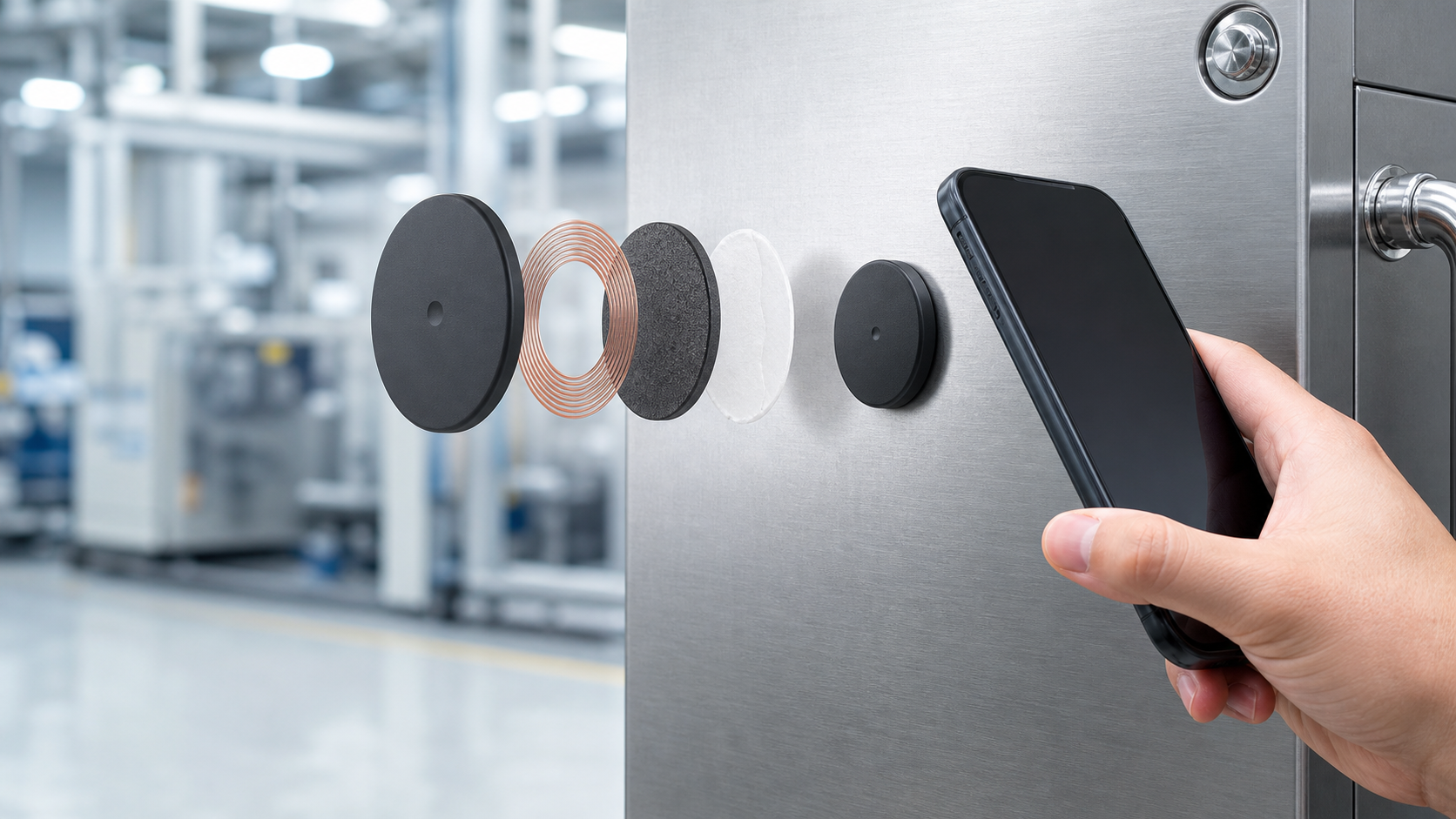
Anti-metal NFC tags are designed for direct attachment to conductive surfaces. A standard NFC sticker often becomes unreadable on steel or aluminum because metal disrupts the antenna's magnetic field. An anti-metal tag adds a ferrite layer between the antenna and the surface, enabling close-range phone or reader interactions on machines, tools, IT assets, containers, and metal packaging.
"Anti-metal" does not mean unlimited range. Results still depend on tag design, size, mounting, reader, metal geometry, and environment.
What Is an Anti-Metal NFC Tag?
An anti-metal NFC tag, also called an on-metal NFC tag, is a 13.56 MHz tag engineered for conductive surfaces. It normally includes an NFC chip, antenna, ferrite, adhesive, and a protective face or enclosure.
Placing a normal antenna against metal can create eddy currents that oppose the reader field and detune the antenna. NXP explains that ferrite between the loop antenna and metal provides magnetic shielding and concentrates magnetic flux. The tag must still be designed and tuned as a complete system.
The practical rule is simple: use a standard NFC label on suitable non-metal materials, and use a purpose-built on-metal construction when the final mounting surface is metal.
| Factor | Standard NFC tag | Anti-metal NFC tag |
|---|---|---|
| Best mounting surface | Paper, plastic, cardboard, wood, glass | Steel, aluminum, tools, machines, metal packaging |
| Shielding layer | Usually none | Ferrite or equivalent isolation layer |
| Typical profile | Thinner and lower cost | Thicker and usually higher cost |
| Performance on metal | Often poor or unreadable | Designed for metal when installed correctly |
| Main selection risk | Surface and liquid interference | Size, mounting, ferrite quality, enclosure, orientation |
1. Equipment Maintenance and Service Records
An NFC tag on a machine, cabinet, pump, or motor can open a service page, inspection form, manual, or asset record. A technician taps at the point of work instead of typing an asset ID. The maintenance platform can then record the user, time, checklist, and result.
2. Tools and Industrial Assets
Anti-metal NFC tags can identify tools, molds, fixtures, instruments, and reusable metal containers. A tap can support check-in, calibration status, instructions, ownership records, or exception reporting.
NFC is best when assets are handled individually. If a warehouse must identify many tagged tools or containers automatically from several meters away, UHF RFID tags may be a better fit.
3. IT Asset Identification
Servers, laptops, network equipment, racks, and cabinets can use on-metal NFC labels for support details, deployment records, or access to an asset-management page. The close tap makes the intended asset clear.
The NFC record should usually contain a controlled URL or identifier rather than sensitive maintenance data. Access control should be handled by the application, not assumed from the tag alone.
4. Product Information and Authentication Workflows
Metal bottles, cosmetic containers, appliance housings, and premium packaging can use anti-metal NFC for manuals, registration, warranty, digital experiences, or authentication workflows.
The security level depends on the chip and system design. A basic URL or UID tag is not automatically a strong anti-counterfeit solution. Cryptographic authentication requires a suitable secure NFC chip, application logic, and backend verification.
5. Inspection and Compliance Checkpoints
On-metal tags can mark inspection points on fire equipment, elevators, utility cabinets, safety stations, and rental equipment. A tap can load the correct checklist, but the software still needs user identity, timestamps, required fields, and exception handling.
- Reliable mounting on conductive assets: The construction addresses interference that disables many ordinary NFC labels.
- Smartphone-friendly interaction: Compatible NFC phones can reduce the need for dedicated scanners.
- Battery-free operation: Passive NFC tags draw power from the reader field and do not require routine battery replacement.
- Intentional asset selection: A close tap helps users interact with one specific machine, tool, or product.
- Flexible digital content: The tag can open a URL, identify an asset, or trigger an app workflow.
- Custom production options: Size, shape, adhesive, housing, printing, UID or serial marking, encoding, and chip choice can be matched to the project.
Limits You Should Understand
NFC Is Still Short Range
The NFC Forum describes NFC as short-range 13.56 MHz technology with a typical connection distance up to about 2 cm. Anti-metal construction does not turn NFC into long-range RFID.
The Reader Must Approach the Correct Side
Ferrite isolates the mounting side, but metal in front can still block the field. A tag behind a metal panel or deep in a recess may not be readable.
Size and Thickness Matter
A larger antenna can provide a more forgiving tap area; a small tag may require precise phone placement. Ferrite and protective materials add thickness, so the smallest tag is not always the best choice.
Durability Comes From the Whole Package
The finished tag must survive the actual moisture, chemicals, abrasion, UV, temperature, impact, or cleaning. A thin sticker and a molded industrial tag can have very different service lives.
Security Is Not Automatic
A UID, writable memory, or password does not guarantee authenticity. Define whether the project needs identification, controlled writing, tamper evidence, or cryptographic authentication.
NFC Is Not Bulk or Real-Time Tracking
NFC requires a close scan of one item. Dock-door reads, bulk inventory, or continuous location tracking may need asset tracking RFID tags, UHF RFID, BLE, GPS, or another technology.
How to Choose and Test an On-Metal NFC Tag
Before ordering, define the metal type, tag area, mounting method, target reader, tap experience, chip and memory, environment, printing, encoding, quantity, and security model.
Test samples on the final asset with target phones, different tap positions, the final adhesive or fastener, protective covers, curved surfaces, nearby metal edges, and the real environment. Include aging or cleaning tests when relevant.
WXR can help compare custom NFC tags, 13.56 MHz RFID tags, and anti-metal RFID tags based on the mounting surface, chip, size, printing, encoding, and durability requirements.
Conclusion
Anti-metal NFC tags use ferrite to support deliberate phone or reader taps on equipment, tools, IT assets, inspection points, and metal packaging. Their limits include short range, one-at-a-time scanning, correct-side access, and security determined by the chip and backend.
Share your metal surface, tag size, reader, environment, encoding, and security requirements with WXR to plan sample testing before mass production.
FAQ
Can a normal NFC sticker work on metal?
Usually not reliably when mounted directly on metal. A small air gap may change performance, but a purpose-built anti-metal NFC tag is the safer choice for a production design.
Many use common NFC Forum tag types that compatible phones can read, but support depends on the chip, data format, phone hardware, operating system, and app. Test the exact tag and workflow on target devices.
How far can an anti-metal NFC tag be read?
NFC is intended for close interaction, typically a tap within a few centimeters or less. Do not publish or purchase based on a fixed read range without testing the exact tag, phone or reader, and metal installation.
They can support an authentication system, but the result depends on the chip and backend. Basic tags are suitable for identification or URL launching; stronger anti-counterfeit applications need secure chips and server-side verification.