
RFID tags are often described as active, passive, or semi-passive. The key difference is how the tag receives power and how it communicates with a reader.
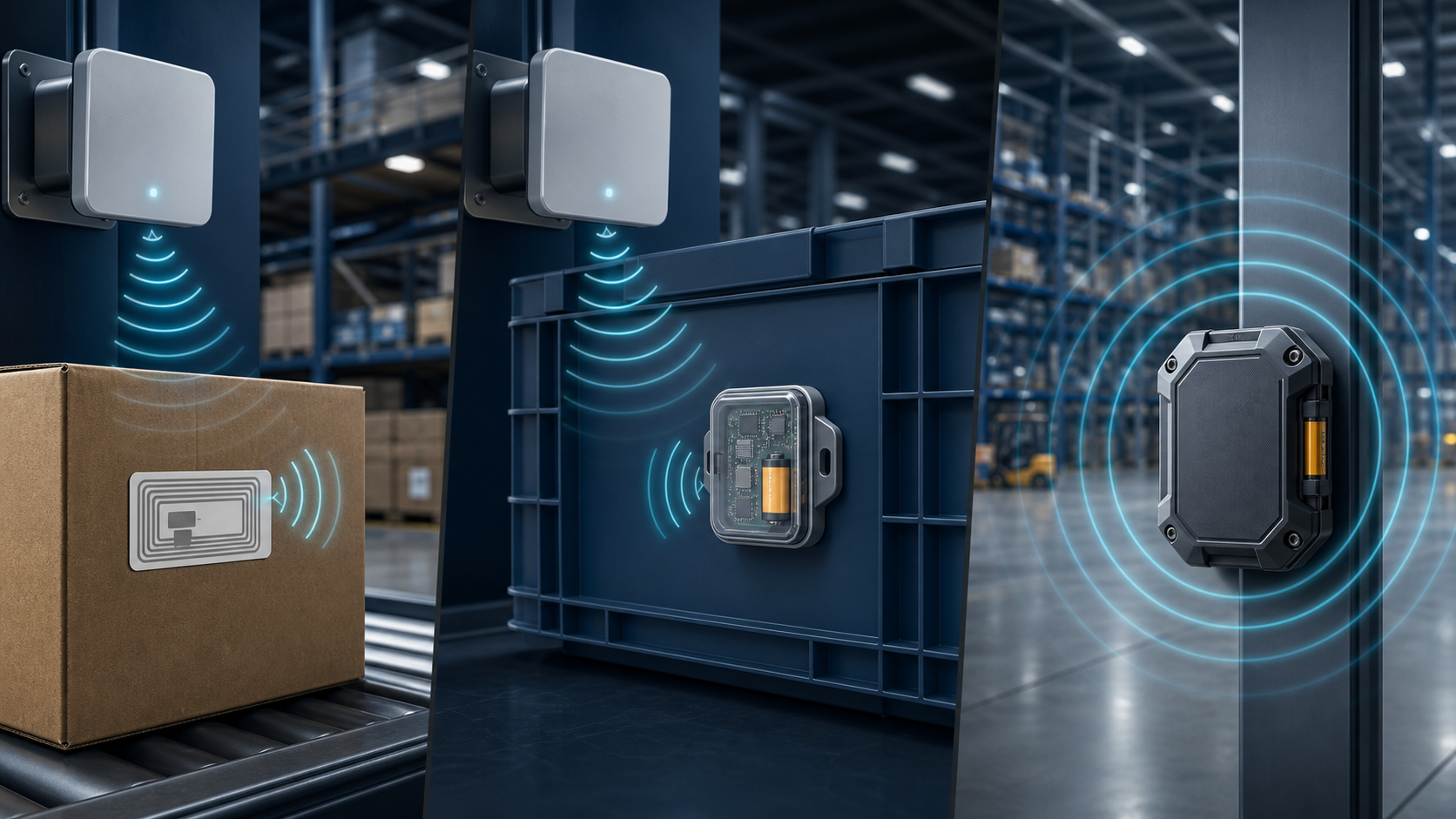
Passive RFID tags have no battery and use energy from the reader. Active RFID tags contain a power source and a radio transmitter that can broadcast a signal. Semi-passive RFID tags contain a battery, but they normally communicate by backscatter like passive tags.
That distinction affects tag size, cost, maintenance, read behavior, sensor capability, and system infrastructure. It does not create a universal ranking in which one type is always better. The right choice depends on what you are tracking and how the RFID system must operate.
Active vs Passive vs Semi-Passive RFID: Quick Comparison
| Feature | Passive RFID | Semi-Passive RFID | Active RFID |
|---|---|---|---|
| Tag power | Energy from the reader | Internal battery assists chip or sensors | Internal battery or another onboard source |
| Communication | Reader-triggered backscatter | Usually reader-triggered backscatter | Onboard transmitter broadcasts or responds |
| Reader dependence | Must be energized and queried | Usually requires a compatible reader query | May beacon without a reader query |
| Typical tag form | Thin label, inlay, card, wristband, or hard tag | Battery-assisted sensor or specialized hard tag | Rugged beacon or transponder |
| Relative range | Usually shortest | Often longer or more reliable than comparable passive tags | Usually longest |
| Relative tag cost | Lowest | Higher than passive | Highest |
| Maintenance | No battery replacement | Battery life must be managed | Battery life must be managed |
| Common applications | Retail, logistics, access, inventory, laundry, item tracking | Condition monitoring, sensor logging, hard-to-read assets | RTLS, vehicles, containers, high-value mobile assets |
These are general tendencies, not guaranteed specifications. Frequency, protocol, reader power, antenna design, orientation, material, interference, and local radio regulations can change real-world performance.
What Is Passive RFID?
A passive RFID tag has no internal battery. When a reader transmits radio energy, the tag antenna captures enough energy to power the integrated circuit. The tag then changes how its antenna reflects the reader's signal, a process called backscatter, to return its stored data.
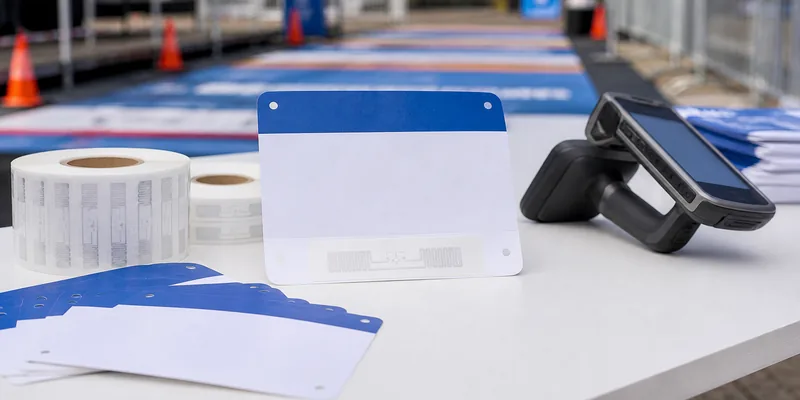
Passive tags remain inactive until a compatible reader energizes and queries them. This architecture allows small, lightweight, and economical labels, inlays, cards, wristbands, and hard tags for large tag populations.
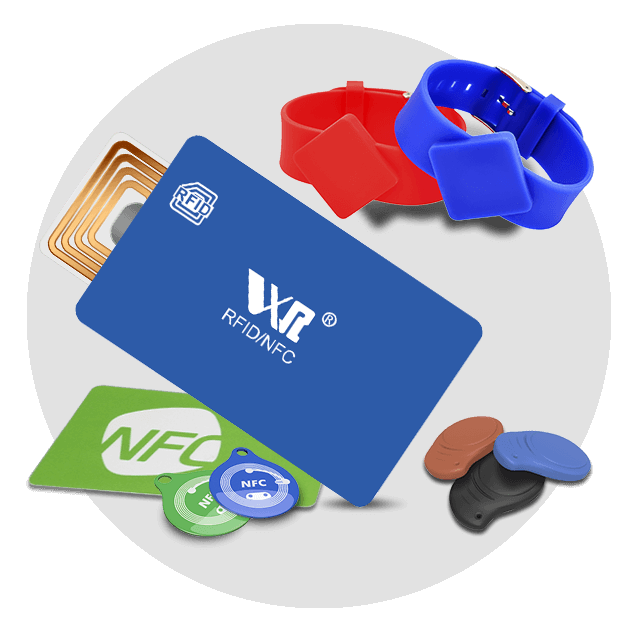
Passive does not mean one frequency. LF, HF/NFC, and UHF RFID can all use passive tags. For example, a close-range access card and a UHF RFID inventory label are both passive, but they use different frequencies, protocols, readers, and workflows.
Passive RFID is usually the best starting point for many tags, low maintenance, flexible formats, or item-level identification. The tag must still receive enough reader energy and return a detectable signal. Metal, liquids, poor orientation, and weak reader placement can reduce performance.
What Is Active RFID?
An active RFID tag has its own power source and transmitter. Depending on the system, it may broadcast an identifier at scheduled intervals or respond after receiving a wake-up signal. Because the tag does not rely on harvested reader energy to power every transmission, active systems can support longer communication distances and frequent location updates.
Active RFID is commonly associated with real-time location systems, vehicle and yard tracking, reusable transport assets, and other high-value objects. Some tags also support sensors, motion detection, or configurable beacon intervals.
The tradeoff is operational complexity. Active tags are larger and more expensive than passive labels, batteries eventually expire, and the project may require gateways, location software, network coverage, and battery monitoring.
Active RFID should therefore be evaluated as a complete system, not just as a longer-range tag.
What Is Semi-Passive RFID?
Semi-passive RFID is also called Battery Assisted Passive RFID, or BAP RFID. Terminology varies between suppliers, so the datasheet should define exactly how the product behaves.
A semi-passive tag contains a battery that can power the chip, memory, clock, or sensors. However, unlike an active tag, it generally does not use an onboard transmitter to broadcast its data. It waits for a compatible reader and returns information by backscatter.
Battery assistance can improve tag sensitivity and support temperature, humidity, pressure, or motion sensing between reads. This makes BAP tags useful for cold-chain monitoring, industrial sensing, and specialized assets where ordinary passive performance is insufficient.
Semi-passive tags still require battery management. Confirm frequency, protocol, sensor commands, reader support, logging, battery life, and software integration before selection.
Why Power Source and Communication Method Both Matter
The easiest way to avoid confusion is to ask two separate questions:
- What powers the tag's chip and sensors?
- How does the tag send information back?
A passive tag gets power from the reader and backscatters. A BAP tag may get power from a battery but still backscatters. An active tag uses onboard power and a transmitter to send a radio signal.
A battery does not automatically make a tag active. A BAP tag may work with compatible passive UHF infrastructure, while an active tag may require a different radio system. Verify compatibility rather than inferring it from the word RFID.
How to Choose the Right RFID Type
Start with the workflow, not the maximum advertised range.
Choose passive RFID to identify many items, minimize tag cost, avoid battery maintenance, or use labels and compact tags. Common examples include retail inventory, apparel, cartons, tools, access credentials, laundry, and warehouse assets.
Choose active RFID for frequent long-range visibility of fewer valuable mobile assets when battery maintenance and dedicated infrastructure are acceptable.
Choose semi-passive RFID when sensing, condition logging, or greater sensitivity justifies a battery while the workflow still uses reader-triggered backscatter.
Before procurement, confirm:
- The operating frequency and protocol.
- Required read points and update frequency.
- Number and value of tagged items.
- Tag size, mounting surface, and enclosure.
- Metal, liquid, temperature, impact, or wash exposure.
- Sensor and memory requirements.
- Battery replacement or disposal plan.
- Reader, antenna, gateway, and software compatibility.
- Regional radio rules and site interference.
- Sample testing under real operating conditions.
Conclusion
Passive, semi-passive, and active RFID are different power and communication architectures. Passive tags are reader-powered and economical at scale. Active tags use onboard power and a transmitter for longer-range or frequent location updates. Semi-passive tags use a battery for circuitry or sensing but usually communicate through backscatter.
For most item-level inventory, access, label, card, inlay, and asset-tagging projects, passive RFID is the practical starting point. WXR supplies customizable RFID inlays, RFID stickers, asset-tracking RFID tags, and anti-metal RFID tags for different materials and environments.
To compare passive tag options, send WXR your application, reader frequency, mounting surface, target read points, tag size, printing, encoding, quantity, and testing environment. Contact WXR to plan samples before mass production. Confirm active or BAP product availability separately if your project requires those architectures.
FAQ
Is semi-passive RFID the same as active RFID?
No. Both may contain a battery, but a semi-passive tag normally uses backscatter and responds to a reader. An active tag has a transmitter and can broadcast or actively respond using onboard power.
Does passive RFID have a shorter range than active RFID?
Generally, yes, but there is no universal range for either type. Performance depends on frequency, tag and antenna design, reader settings, orientation, materials, interference, protocol, and local regulations.
Passive tags have no battery to expire, but physical life still depends on the chip, antenna, adhesive, housing, heat, chemicals, moisture, bending, and impact.
Can active and passive RFID use the same reader?
Usually not. The systems may use different frequencies, protocols, and reader infrastructure. Some BAP products work with compatible passive-backscatter systems, but reader and software support must be confirmed.
Which RFID type is best for inventory tracking?
Passive UHF RFID is commonly the best starting point for item, case, pallet, apparel, and warehouse inventory because tags can be small and economical at scale. Active RFID is more suitable when the project requires frequent location updates for fewer high-value assets.