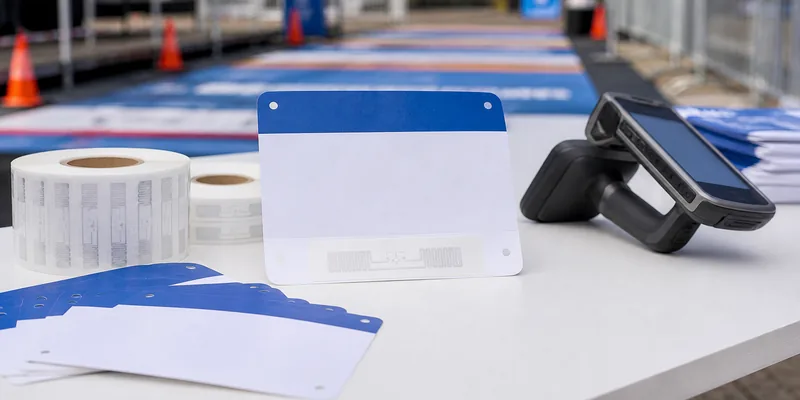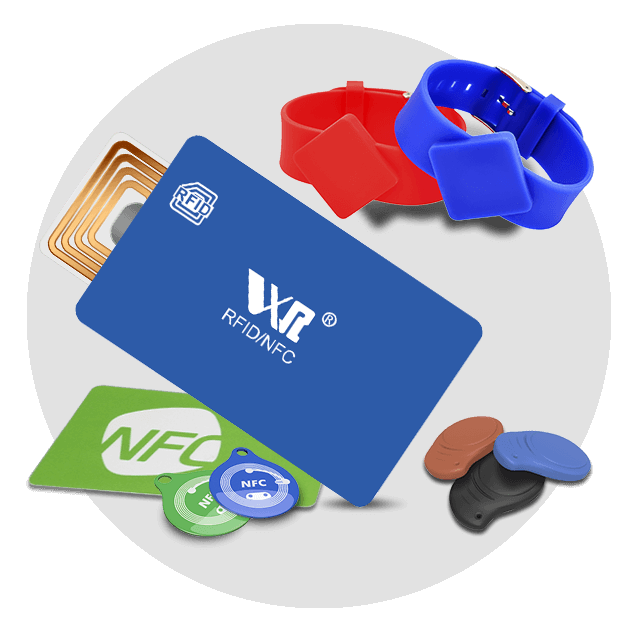

Yes, many RFID tags can be rewritten, but not all of them. Whether an RFID tag can be rewritten depends on the tag type, chip memory, frequency, reader software, and lock settings.
The short version is simple: read/write RFID tags can usually be rewritten, read-only RFID tags cannot, and locked RFID tags may require a password or may be impossible to change.
That answer matters because “RFID tag” can mean many products: UHF inventory labels, NFC stickers, hotel key cards, access control fobs, laundry tags, animal tags, and industrial hard tags. Some are designed to be updated. Others are designed to hold a fixed ID for the life of the tag.
What Does Rewriting an RFID Tag Mean?
Rewriting an RFID tag means changing data stored in the tag chip. This is different from reading the tag. Reading retrieves stored data wirelessly. Writing, also called encoding, sends a command that changes data in a writable memory area.
In many RFID systems, the tag does not store a full product record. It stores an ID, while software stores richer information such as product name, owner, location, batch number, or maintenance history. This is why rewriting the tag is not always necessary. Often, you can keep the tag ID unchanged and update the database instead.
Which RFID Tags Can Be Rewritten?
RFID tags generally fall into three practical groups.
Read-only RFID tags have data programmed by the manufacturer or supplier and are not meant to be changed. They are used when stable identity matters more than flexibility.
Write-once or locked tags can be encoded during production or commissioning, then locked to prevent duplicate IDs, accidental overwriting, or tampering.
Read/write RFID tags allow data to be changed in supported memory areas. These tags are used when the application needs reusable labels, changing asset states, service data, or custom information stored directly on the tag.
So the real question is not only “Can RFID tags be rewritten?” It is “Which memory bank do you want to rewrite, and has that memory been locked?”
RFID Memory Banks: EPC, TID, User, and Reserved
For UHF RFID tags using EPC Gen2 / RAIN RFID, memory is commonly discussed in four banks: Reserved, EPC, TID, and User memory.
EPC memory is the most commonly used writable area. It stores the Electronic Product Code or another item identifier. In retail, logistics, and asset tracking, EPC memory acts like a digital license plate. Many UHF RFID tags allow EPC memory to be written during encoding and sometimes rewritten later if it is not locked.
TID memory stands for Tag Identifier. It is usually programmed by the chip manufacturer and is generally not editable. TID can identify the chip model and sometimes include a unique serial number, so it is useful for chip verification and anti-counterfeiting checks.
User memory is optional. Some chips include it, while others do not. When available, it can store custom data such as a maintenance date, production batch, configuration flag, or service note. Use it carefully because extra data takes more time to read and write.
Reserved memory stores access and kill passwords. In some systems, an access password protects writing or locking behavior.
Can Locked RFID Tags Be Rewritten?
Sometimes, but not always. RFID memory can be unlocked, password-protected, locked, or permanently locked depending on the chip and how it was configured.
If memory is temporarily locked, authorized software may unlock it with the correct access password and write new data. If memory is permanently locked, often called permalocked, it cannot be rewritten. Permanent locking protects important identifiers after commissioning.
Before buying tags, ask whether EPC memory, User memory, or both can be locked, unlocked, or permanently locked. The answer varies by chip family and reader software.
How Many Times Can RFID Tags Be Rewritten?
Many modern writable RFID chips support thousands of write cycles. Some UHF RFID guidance describes typical write endurance in the range of 10,000 to 100,000 writes per memory location, depending on the chip.
In real projects, most tags are not rewritten constantly. A warehouse label may be encoded once. A reusable container tag may be updated occasionally. If your application needs frequent rewriting, confirm chip endurance in the datasheet and test before deployment.
NFC Tags and Rewriting
NFC tags are a type of HF RFID operating at 13.56 MHz, and many NFC tags can be rewritten. Common NFC stickers used for URLs, product information, or mobile interactions often allow their NDEF data to be updated.
However, NFC tags can also be locked. Some apps offer a “make read-only” function. Once permanently locked, the NFC tag may still be readable, but the stored content cannot be changed.
When Should You Use Rewritable RFID Tags?
Rewritable RFID tags are useful when the tag itself needs to carry changing data. Common examples include reusable transport items, returnable containers, work-in-process tracking, maintenance records, event credentials, hotel cards, and temporary asset assignments.
For simple inventory tracking, rewriting may not be needed. You can encode a stable EPC once and update everything else in software. This is usually more scalable than storing too much changing information on the tag.
Choose read/write RFID tags when your process benefits from changing tag data. Choose locked or read-only behavior when identity stability and tamper resistance matter more.
How to Choose the Right RFID Tag
Before choosing a rewritable RFID tag, define the exact job the memory must do:
- Which frequency do you need: LF, HF/NFC, or UHF?
- Which memory area must be writable: EPC, User memory, or both?
- Does the chip include enough User memory for your data?
- Should the tag be rewritten many times, or only encoded once?
- Will the memory need password protection or locking?
- Is permanent locking required after encoding?
- Can your reader and software write, verify, lock, and unlock the tag correctly?
- Should the data live on the tag, or is it better stored in a database?
These questions prevent a common mistake: buying tags based only on shape, read range, or price. Memory behavior can be just as important as physical format.
Conclusion
RFID tags can be rewritten when they use writable memory and that memory has not been permanently locked. In UHF RFID, EPC memory and User memory are the main areas people write or rewrite. TID memory is generally factory-programmed and not editable.
For reusable assets, service workflows, NFC campaigns, and changing assignments, read/write RFID tags can be a strong choice. For product identity, access control, compliance, and anti-tampering, locking after encoding may be safer.
Choose the tag based on frequency, chip memory, lock behavior, reader compatibility, and software workflow. If rewriting is important, confirm it before ordering, then test writing, reading, locking, and verification under real operating conditions.
FAQ
Can all RFID tags be rewritten?
No. Some RFID tags are read-only, some can be written once and locked, and some are read/write tags that can be rewritten if memory is not permanently locked.
Can a locked RFID tag be rewritten?
It depends on the lock state. A password-protected tag may be unlocked by authorized software. A permanently locked tag usually cannot be rewritten.
Which part of a UHF RFID tag is rewritable?
EPC memory is commonly writable, and User memory is writable when the chip includes it. TID memory is generally programmed by the manufacturer and not editable.
Can NFC tags be rewritten?
Many NFC tags can be rewritten, especially before they are locked. If an NFC tag is permanently locked or made read-only, its content usually cannot be changed.
Should RFID data be stored on the tag or in software?
For most systems, store a stable ID on the tag and keep detailed business data in software. Use tag memory for extra data only when the workflow truly needs it.
Need rewritable RFID tags, NFC tags, or UHF labels with specific EPC, User memory, or locking requirements? Contact WXR to choose the right chip, tag format, and encoding workflow for your application.