Choosing RFID key fobs is not just a matter of picking a shape and color. For a real access control, membership, hotel, campus, parking, or industrial project, the right RFID key fob must match the reader, frequency, chip protocol, security level, working environment, and daily usage habits of the people who carry it.
A good RFID key fob should be easy to carry, reliable to scan, durable enough for the project environment, and compatible with the system already installed or being deployed. The simplest way to choose is to start with the technical requirements first, then move to material, design, encoding, and supplier quality.
1. Start With the Application
Before comparing RFID key fobs, define where and how they will be used. A residential access control project has different needs from a gym membership system or a logistics site.
Common RFID key fob applications include:
- Apartment and office access control
- Hotel room access and staff access
- Gym, club, and membership check-in
- School and campus identification
- Parking lot entry
- Locker systems
- Cashless payment or stored-value systems
- Industrial equipment authorization
For example, an apartment project may prioritize low cost, simple ID reading, and long-term durability. A corporate office may need higher security and encrypted credentials. A swimming pool or outdoor site may require waterproof housing and stronger physical protection.
2. Match the RFID Frequency
Frequency is one of the most important decisions because it determines whether the key fob can communicate with your RFID reader.
The three common RFID frequency groups are LF, HF, and UHF.
| Frequency Type | Common Frequency | Typical Use |
|---|---|---|
| LF | 125 kHz or 134.2 kHz | Basic access control, animal ID, older systems |
| HF | 13.56 MHz | Access control, NFC, membership, payment, smart cards |
| UHF | 860-960 MHz | Long-range asset tracking, logistics, parking |
Most RFID key fobs used for door access are LF 125 kHz or HF 13.56 MHz. UHF key fobs exist, but they are less common for close-range door access and more often used where longer reading distance is needed.
If your project is replacing existing fobs, do not guess the frequency. Check the reader model, old fob chip type, system documentation, or ask the system integrator. A 125 kHz fob will not work with a 13.56 MHz reader unless the reader supports both.
3. Confirm the Chip Type and Protocol
Two RFID key fobs can look identical but behave completely differently inside. The chip determines memory, protocol, read/write capability, and security.
Common low-frequency chips include EM4100, TK4100, T5577, and HID-compatible options. Common high-frequency options include MIFARE Classic, MIFARE Ultralight, MIFARE DESFire, NTAG, and ICODE series chips.
For simple ID access, a read-only or basic UID chip may be enough. For secure access, payment, or multi-application systems, choose a chip with better authentication and encryption, such as DESFire-based options, depending on your system compatibility.
A practical rule: choose the chip based on the reader and software platform, not based on price alone. The lowest-cost fob can become expensive if it fails during enrollment or cannot support the required security format.
4. Decide the Required Security Level
Security requirements vary widely. A basic gym check-in system may only need a unique ID. A corporate office, hotel, or restricted facility may need stronger protection against cloning and unauthorized duplication.
Ask these questions:
- Does the system only read the UID?
- Is encrypted authentication required?
- Can lost fobs be deactivated quickly?
- Does the project require sector encoding or custom data?
- Are anti-cloning features important?
- Who is allowed to duplicate or issue new fobs?
For higher-risk projects, avoid relying only on simple UID-based credentials. Work with the access control provider or RFID supplier to choose a chip and encoding method that matches the system’s security model.
5. Choose the Right Material and Housing
RFID key fobs are carried on keychains, dropped, scratched, exposed to moisture, and used many times per day. Material choice affects both lifespan and user experience.
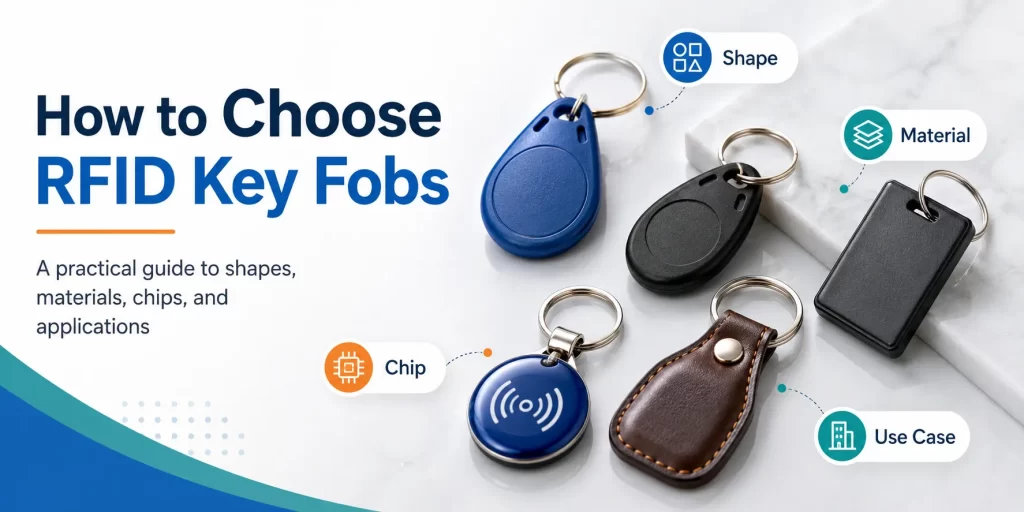
Common materials include ABS, PVC, epoxy, silicone, leather, and metal-composite designs. ABS RFID key fobs are widely used because they are durable, cost-effective, and suitable for everyday access control. Epoxy fobs offer a glossy, branded look and better surface protection. Silicone fobs are flexible and comfortable, often used in leisure, sports, and waterproof environments.
For outdoor or wet environments, choose waterproof or sealed RFID key fobs. For industrial sites, ask about impact resistance, temperature range, and chemical exposure. For premium membership programs or branded venues, surface finish, logo quality, and color consistency may matter as much as technical performance.
6. Think About Size, Shape, and User Convenience
A key fob should be easy to carry and easy to scan. Small fobs are convenient, but extremely compact designs may reduce antenna size and reading performance. Larger fobs may scan more reliably but can feel bulky on a keychain.
Popular shapes include teardrop, oval, rectangle, round, shield, and custom molded shapes. For high-volume projects, standard shapes are usually more economical and faster to produce. For brand-focused projects, custom shape and color can make the fob feel more like part of the customer experience.
If users include children, hotel guests, gym members, or temporary visitors, choose a design that is simple to identify, hard to damage, and easy to return or replace.
7. Plan Encoding, Numbering, and Printing
Many RFID key fob orders fail not because of the fob itself, but because the encoding or numbering was not specified clearly.
Before ordering, confirm whether you need:
- Blank fobs
- Pre-encoded fobs
- UID reading only
- Sequential ID numbers
- Laser engraving
- Printed serial numbers
- QR codes or barcodes
- Logo printing
- Color coding by user group or access level
For access control projects, it is often useful to print or engrave a visible number on each fob. This makes issuing, tracking, and replacing fobs much easier for administrators.
If the fobs must be encoded before delivery, provide the exact data format, byte order, facility code, card number range, or sample fob data. When possible, test samples before mass production.
8. Request Samples Before Bulk Ordering
For real-world projects, sample testing is the safest step. Test the fob with the actual reader, actual software, and actual installation distance. Do not rely only on datasheets.
During sample testing, check:
- Read distance
- Reading speed
- Enrollment process
- Compatibility with existing fobs
- Performance near metal or moisture
- Durability of the key ring hole
- Print and logo quality
- User comfort
A sample that works on a desktop reader may not perform the same on a wall-mounted reader behind glass, metal, or outdoor housing. Real installation testing prevents expensive reorders.
9. Evaluate the RFID Key Fob Supplier
A reliable supplier should help confirm frequency, chip, material, encoding, printing, and packaging before production. For custom RFID key fobs, supplier experience matters because small specification errors can affect the entire batch.
Look for a supplier that can provide:
- Chip and frequency options
- Sample support
- Custom printing or engraving
- Encoding service
- Consistent quality control
- Clear lead time
- Packaging options
- Technical compatibility support
For repeat projects, ask whether the supplier can keep production records, color references, and encoding rules for future reorders.
Final Checklist Before You Order
Before approving production, confirm these details:
- Application and use environment
- Reader frequency
- Chip type and protocol
- Security requirements
- Material and waterproof needs
- Shape, size, and color
- Logo, printing, or engraving
- Encoding and numbering format
- Sample test result
- Quantity, lead time, and packaging
The best RFID key fob is the one that fits the project, not simply the one with the lowest unit price. When frequency, chip, material, security, and encoding are aligned from the start, RFID key fobs become a reliable part of the system instead of a source of installation problems.
FAQ
What is the best RFID key fob for access control?
The best option depends on your reader and security requirements. Many access control systems use 125 kHz LF or 13.56 MHz HF key fobs, but the chip type must match the installed system.
Can RFID key fobs be customized with a logo?
Yes. Most RFID key fobs can be customized with logo printing, laser numbering, color matching, epoxy finish, or custom packaging.
Are 125 kHz and 13.56 MHz RFID key fobs interchangeable?
No. They use different frequencies and protocols. A fob must match the reader’s supported frequency and chip type.
Should I choose waterproof RFID key fobs?
Choose waterproof or sealed fobs for outdoor access, swimming pools, gyms, resorts, industrial areas, or any environment exposed to moisture.
Need RFID key fobs for an access control, membership, hotel, or campus project? Request samples first and confirm the frequency, chip, material, and encoding before placing a bulk order. Contact WXR.