
RFID Wristbands

Take a break and read all about it

How to Encode and Program RFID Silicone Wristbands in Bulk
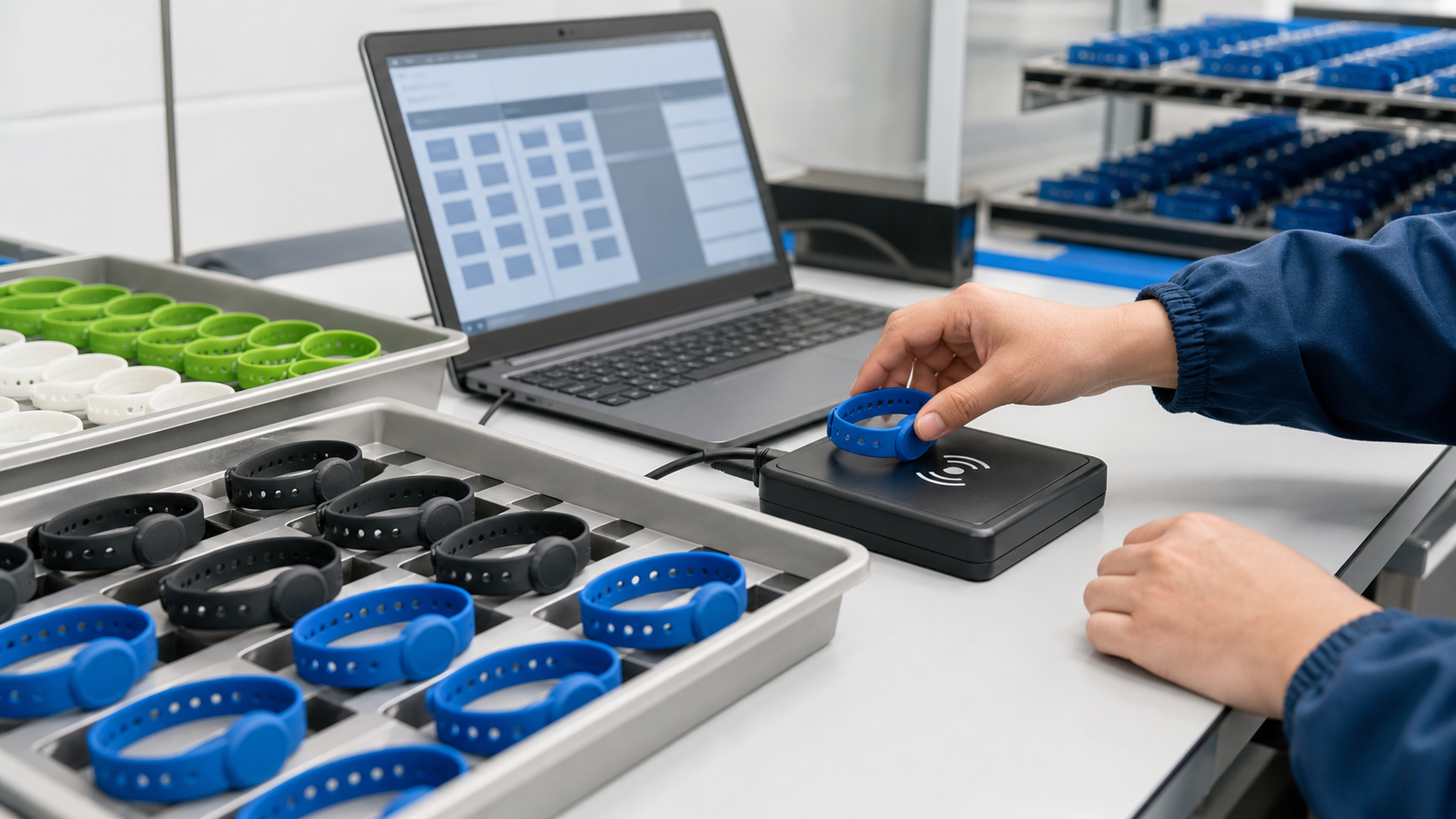
Technician bulk encoding colorful RFID silicone wristbands on a desktop RFID reader.

Bulk encoding RFID silicone wristbands is not just placing a wristband on a reader and clicking “write.” A reliable process starts with the right chip, a clean data file, compatible software, controlled tag handling, and a verification record.

For events, gyms, spas, hotels, hospitals, amusement parks, and access-control projects, every wristband should match the correct user, serial number, URL, access level, or account before deployment. This guide explains how to prepare, encode, verify, and hand off RFID silicone wristbands in bulk.

Quick Answer: What Does Bulk Encoding Mean?

Bulk encoding means writing planned data to many RFID wristbands in a controlled sequence, then reading each wristband back to confirm it is correct. The data may be an NFC URL, membership ID, access credential, EPC number, User memory value, or database reference.

A safe workflow is simple: confirm the chip, prepare one clean CSV row per wristband, write one controlled record at a time, verify the read-back value, lock or secure data only after testing, and keep UID, printed number, and encoded value mapped in one file.

Step 1: Confirm the RFID Chip and Frequency

The encoding method depends on the chip inside the silicone wristband. A reader for one frequency cannot program every wristband type.

Wristband type Common chips What can usually be encoded
LF 125 kHz wristbands TK4100, EM4100, EM4305, T5577 Fixed UID or simple rewritable ID, depending on chip
HF 13.56 MHz wristbands MIFARE Classic, MIFARE Ultralight, NTAG213/215/216, DESFire Access data, NDEF records, sector data, application data
UHF 860-960 MHz wristbands EPC Gen2 / RAIN RFID chips EPC memory, sometimes User memory, depending on chip

For many silicone wristband projects, HF 13.56 MHz is common because it fits access control, membership ID, event check-in, hotel or spa workflows, and NFC phone interactions. NTAG wristbands are often used for URLs or app links. MIFARE or DESFire wristbands are more common when the wristband must work with a closed access-control or payment system.

If your project needs longer read distance, review whether a UHF RFID tag format is suitable. If the project is NFC or access-control focused, start with 13.56 MHz RFID tags and confirm reader compatibility.

Step 2: Decide What Data Should Be Written

Before programming begins, decide whether the wristband will use the factory chip UID, a custom encoded value, or both. The chip UID is commonly used as a database key. Your software reads the UID and connects it to a user profile, ticket, room, locker, or membership account.

Custom encoded data is useful when the wristband must store a specific value, such as a membership number, NFC URL, access-control credential, UHF EPC number, User memory value, batch code, project code, or location code.

Avoid writing private customer data directly to the wristband unless your system, chip security, and privacy policy are designed for it. For secure access or payment, work with your system provider to define the correct chip type, keys, and authentication method.

Step 3: Prepare the Encoding File

Bulk encoding is easiest when the data is structured before production. A CSV file should contain one row per wristband. Useful columns include visual serial number, chip UID if already captured, encoded value, NDEF URL, EPC value, access group, printed QR or barcode, lock status, batch number, and packing sequence.

This file becomes the bridge between production, quality control, and your software import. If WXR pre-encodes wristbands before shipment, the same file can match printed serials, encoded values, and packing order.

Step 4: Set Up the Bulk Encoding Station

For LF and HF wristbands, use a desktop RFID or NFC reader that supports the target chip. A basic NFC writer may handle NTAG NDEF writing but may not support a secure MIFARE sector workflow. For UHF wristbands, use a UHF reader and software that can write EPC memory and verify the tag after writing.

The physical setup matters. Keep unencoded and encoded wristbands in separate trays. Present only one LF or HF wristband to the reader field at a time unless your system is designed for multi-tag handling. For UHF, control the read zone carefully because nearby tags may be detected unintentionally.

Step 5: Write, Read Back, and Verify Every Wristband

A practical workflow looks like this:

  1. Import the CSV file into the encoding software.
  2. Place one wristband on the reader or encoding fixture.
  3. Write the planned data to the correct memory area.
  4. Read the wristband back immediately.
  5. Compare the read-back value with the source file.
  6. Mark the record as passed, failed, or rewritten.
  7. Move the wristband to the correct output tray.

Verification is the most important part of bulk programming. A wristband that writes successfully but is mapped to the wrong printed number can still fail in the field. For printed serials, QR codes, or barcodes, verify the visual ID and encoded value together.

Step 6: Lock or Secure the Data at the Right Time

Many chips can be locked, password-protected, or configured to prevent unwanted rewriting. This is useful for event admission, cashless payment, and access-control projects, but it should happen only after sample testing.

Do not lock a full batch too early. First test the wristbands with real readers, gates, kiosks, mobile phones, POS terminals, or access-control panels. Once certain memory areas are locked, changing the data may be impossible or may require a predefined key process.

For NFC tags, confirm whether the NDEF data should remain rewritable, be soft locked, or be permanently locked. For MIFARE, confirm sector keys and access bits with the system provider. For UHF, confirm whether EPC, TID, and User memory are required. The GS1 EPC Tag Data Standard is a useful reference for EPC-based structures.

Step 7: Run Quality Control Before Shipment

Quality control should include sample inspection for color, size, logo printing, and silicone finish; reader compatibility testing; data read-back checks; duplicate-value checks; lock-status checks; and packing checks by serial number, color, or batch.

For high-risk projects, 100% electronic verification is recommended, especially when the wristband is linked to payment, personal access, paid tickets, or guest identity.

Common Bulk Encoding Mistakes

The most common mistake is choosing the wristband before confirming the reader system. A silicone wristband may look correct but contain the wrong chip. Other avoidable problems include assuming the UID can be changed, writing multiple wristbands at once, using duplicate CSV values, locking memory before testing, mixing batches after encoding, and skipping real-system testing.

Should You Encode In-House or Ask the Factory?

In-house encoding makes sense when you need last-minute user assignment, daily membership updates, or direct control inside your software. Factory pre-encoding is better when the data is known before production and you want wristbands delivered ready for deployment.

WXR can customize RFID wristbands with chip selection, silicone color, logo printing, UID or serial printing, QR/barcode printing, and data encoding. For projects that need controlled matching between printed numbers and encoded values, factory pre-encoding can reduce setup time and error risk.

What to Send Your RFID Wristband Supplier

To avoid delays, send your application, frequency, chip requirement, reader model, encoding format, CSV data file, printing needs, quantity, packing sequence, deadline, and lock requirement.

If you are not sure which chip fits your system, contact WXR with your reader model, application, and sample data requirement. The team can recommend a suitable wristband chip and prepare samples before mass production.

FAQ

Can RFID silicone wristbands be programmed in bulk?

Yes. RFID silicone wristbands can be programmed in bulk if the chip is writable and the encoding station uses a compatible reader, software, and verification process. Some chips are read-only, so confirm the chip type before ordering.

Can I change the UID of an RFID wristband?

Usually no. The manufacturer UID is normally fixed. Some special rewritable or clone-style chips exist, but they should be used only when the system specifically supports them and the security implications are understood.

Which chip is best for NFC wristband programming?

For simple NFC phone interactions, NTAG213, NTAG215, and NTAG216 are common options. NXP documents these as NFC Forum Type 2 Tag compatible chips with different user-memory sizes, so choose based on data length and project requirement.

How do I avoid duplicate encoded values?

Use a controlled CSV file, check for duplicates before writing, and read back every wristband after encoding. Keep the final mapping file with UID, printed serial number, encoded value, and packing sequence.

Should RFID wristbands be locked after encoding?

Locking is useful when the data should not be changed after deployment. However, lock only after sample testing, full data verification, and confirmation from the software or access-control provider.

Conclusion

The best way to encode RFID silicone wristbands in bulk is to treat encoding as a production workflow, not a manual afterthought. Confirm the chip, prepare clean data, write one controlled record at a time, verify every wristband, and lock data only after testing.

For event, gym, spa, hospital, hotel, and membership projects, WXR can help match the wristband chip, material, printing, encoding, and packing sequence to your deployment workflow. Share your reader system, data format, and quantity to request samples or a custom quote.

The Benefits of RFID Wristbands for Theme Parks

RFID (Radio-Frequency Identification) technology has been around since the early 2000s and is now being used in a variety of applications, including theme park wristbands. These wristbands are a convenient way for theme parks to manage their customers’ information and provide an extra layer of security. Let’s take a look at some of the benefits that RFID wristbands offer to theme parks.

Enhanced Security & Fraud Prevention

RFID wristbands reduce the risk of fraud by providing tamper-proof identification. By using an encrypted ID number, the wristband can be used as an authentication tool to ensure that only valid customers enter the park. This helps prevent unauthorized access, which can lead to lost revenue for the park. Additionally, RFID wristbands help reduce the risk of identity theft by allowing customers to register their details securely online before entering the park.

Improved Customer Experience

RFID wristbands allow customers to easily access attractions without having to queue up or wait in line. This makes it easier and more enjoyable for customers, as they don’t have to worry about carrying around tickets or cards with them at all times. Plus, it eliminates long waits at ticketing kiosks. Additionally, RFID wristbands allow parks to track customer activity and preferences so they can tailor their experience accordingly.

Efficient Staff Management

Cost Savings & Revenue Generation  RFID technology also offers cost savings and revenue generation opportunities for theme parks by providing better visibility into how guests are spending their money within the park. For example, RFID tags can be used to track customer purchases and monitor customer behavior in real time. This data can then be used to make informed business decisions such as offering discounts or special promotions based on customer preferences or usage patterns. In addition, it helps parks identify areas where they could improve operations and increase efficiency while reducing costs associated with staffing and labor costs related to ticket sales operations.

Conclusion:

RFID technology offers many benefits for theme parks looking to maximize customer satisfaction while minimizing operational costs and improving security measures across the board. With its ability to provide secure identification, efficient staff management, improved customer experience, cost savings & revenue generation opportunities; it’s no wonder why so many theme parks are turning towards this innovative technology when looking for ways to enhance their operations! Whether you’re purchasing personnel or corporate executives making decisions about system integrators; you should consider implementing RFID technology today!

How RFID Wristbands Can Enhance Your Marketing Campaigns

RFID (Radio Frequency Identification) wristbands are no longer just for events and clubs. They are becoming increasingly popular for marketing campaigns, due to their ability to enhance the customer experience and boost engagement with social media. But what exactly are RFID wristbands and how can they be used for marketing? Read on to find out!

What are RFID Wristbands?

RFID wristbands are accessories that contain a unique ticket information about an attendee or person. The chip is placed inside the band, but is invisible when looking from the outside. Attendees can use these wristbands as a VIP pass, payment processor during an event, and much more. They provide a secure and convenient way to keep track of who enters an event or venue, while also providing additional services such as access control and cashless payments.

Benefits of Using RFID Wristbands for Marketing

RFID wristbands provide marketers with several benefits that can help increase engagement with customers. First off, they create an awesome factor that gets people talking about your brand. This helps build customer loyalty and encourages word-of-mouth marketing.

Secondly, it provides a great platform for incentivizing customers to like and share posts on social media in exchange for rewards or discounts. And finally, it makes events more enjoyable by streamlining processes such as check-in times and payment methods.

Conclusion:

In conclusion, RFID wristbands have become a popular tool in the world of marketing due to their ability to enhance the customer experience while boosting engagement with social media platforms. They provide convenience to both marketers and customers alike by streamlining processes such as check-in times and providing access control without having to use physical tickets or cards. For these reasons, system integrators,purchasing personnel, corporate executives should consider using RFID wristbands in their next marketing campaign!

RFID Wristbands for Music Events

Radio-frequency identification (RFID) has become a popular technology for many different industries, and now it’s being used as a way to enhance the guest experience at music events. By using RFID wristbands, event guests can easily access their tickets, purchase merchandise and food items, and even log in to social media accounts during the event. Let’s take a closer look at how RFID wristbands can improve the music event experience.

What Are RFID Wristbands?

RFID wristbands are made up of two parts: an RFID tag that is embedded within the wristband itself, and an antenna that reads and transmits data from the tag. These wristbands are often made of silicone or plastic and come in a variety of colors and styles. Each RFID tag contains unique information about each individual user which makes them ideal for use at large events where there will be multiple attendees.

How Do They Work?

At music events, attendees can register their tickets by scanning their RFID wristbands at entry points throughout the venue. This allows them to quickly get into the event without having to wait in line with paper tickets or printed barcodes. During the event, they can also use their wristband to purchase merchandise or food items without needing to carry cash or cards around with them. Additionally, they can even link their social media accounts so that they can easily post photos and videos from the event without needing to log in manually every time.

What Are The Benefits?

For event organizers, one of the biggest benefits of using RFID wristbands is increased security since each band contains unique information about each attendee. This helps prevent fraud as well as unauthorized reselling of tickets since it eliminates paper tickets that can be copied or duplicated easily. Additionally, it allows them to track attendance more accurately which helps with crowd control management as well as providing detailed analytics on who attended their events. Furthermore, they are able to collect valuable customer data such as age range and interests which can help them better tailor future events accordingly.

Conclusion:

With its ability to provide quick access entry points, secure payment options, and detailed analytics on attendees’ movements throughout an event venue, it’s easy to see why RFID wristbands have become popular among music venues looking for a way to improve their guest experience while also increasing security measures and collecting valuable customer data at the same time. Whether you are a system integrator, purchasing personnel, or corporate executive looking for ways to enhance your music venue’s operations—RFID technology is definitely something worth exploring!

Why You Need RFID Wristbands for Gym

Are you looking for ways to better engage with members of your gym and provide an unforgettable user experience? Look no further than RFID wristbands! These convenient tools are revolutionizing how gyms keep track of their patrons, offering a personal touch that encourages customer loyalty.

With RFID (Radio Frequency Identification) wristbands, it’s easy to offer incentives to regular customers, monitor usage levels & adjust pricing, and track new demographics. Keep reading to learn more about how these cutting-edge gadgets work, what they can do, and why they should become part of your arsenal today.

What is RFID Technology, and How Does It Work?

When you hear wireless technology, you probably think of Wi-Fi or Bluetooth. What if we told you there’s a wireless technology that’s more efficient than Bluetooth? That’s right – RFID technology is the new wave of wireless communication, and it promises to revolutionize many industries.

Radio Frequency Identification (RFID) uses wireless radio signals to identify, track and manage objects. Its magnetic induction concept is similar to short-range Bluetooth technology, but it uses a wider range of frequencies.

To use this technology at your gym, you must provide each member with an RFID wristband. This wristband contains a microchip that can be programmed with information, including membership details and the number of visits.

You will then install an RFID reader in your gym. This reader consistently emits radio waves, which are picked up by the wristband’s chip. The chips’ integrated circuit is excited by the radio waves, releasing a small amount of energy. This energy is used to transmit data back to the reader.

Once the reader receives the data, it decodes it and sends it to the central database. This enables you to get well-analyzed and presented data on your gym members, including their visit frequency and other details.

Why You Need RFID Wristbands for Gym

A gym is a busy place that is always bustling with activity. This means that it can be quite difficult to keep track of all your members, which can lead to a lot of problems. Some common issues faced by gyms include:

  • Poor Customer Service. If you do not track your gym members and their activities, you will struggle to provide high-quality customer service. For example, if a member fails to show up for their workout session, you may not be able to contact them and reschedule it. This can lead to frustration among your members, reducing their satisfaction with your gym.
  • Inefficient Management. Managing a gym is no easy task. It requires time and effort, especially if you have a large membership base. When overwhelmed, it is easy to miss out on critical details.
  • Increased Security Risks. A gym is a public space that attracts all kinds of people – including those not interested in working out. This means that there is a risk of theft and vandalism.
  • Segmentation Problems. Most gyms have female and male-only zones. This segmentation is critical since it helps members work out in a more comfortable environment. If you fail to track members’ genders, you may inadvertently allow men & women into the same zone.

These problems can drive your members away and affect your gym’s reputation. As such, you must devise an efficient tracking system to ensure all your members are comfortable & satisfied. RFID wristbands for gyms are the perfect solution to all these problems.

Benefits of Using RFID Wristbands for Gym

Easy Branding

The gym industry is super competitive, making it critical for fitness centers to stand out from their competitors. One of the best ways to do this is through consistent branding efforts. With RFID wristbands, you can easily incorporate your brand’s color scheme or logo into the wristbands’ design.

Your clients will love the customized look of their wristbands, and this can encourage them to wear them for longer periods. This will greatly enhance brand awareness and create a stronger bond between your customers and the gym.

Increased Security & Reduced Risk of Vandalism

In most instances, clients will undress before working out. This will leave their valuables and other possessions vulnerable to theft or vandalism.

Most gyms provide lockers for gym members, but these lockers are not 100% secure. RFID wristbands can provide an extra layer of security by acting as a secondary lock for your members’ valuables. Only the RFID wristband holder can access the locker, which significantly reduces the risk of theft and vandalism.

Additionally, it is harder to lose a wearable RFID wristband than a physical key. As such, you can be confident that your gym members’ belongings are safe and secure at all times.

Enhanced Data Collection & Analysis

The success of most gyms depends on how well they collect, analyze, and present data related to their customers. RFID wristbands make it easy for you to track your members’ visit frequency, workout intensity, and other data points.

You can then use this information to identify trends and make more informed business decisions, such as enhancing your membership plans or offering new services. In addition, you can monitor changes in the average time spent at the gym by different demographics – which will help you tweak your marketing strategies accordingly.

Increased Revenues

When you offer improved customer service, reduce security risks, and boost data collection & analysis capabilities, your gym’s reputation will improve. This will lead to an increase in memberships and higher revenues for your gym business.

Additionally, you can incorporate different services (such as personal training or massages) into your members’ RFID wristbands. This can encourage them to spend more time and money at your gym, thus increasing revenue opportunities.

Other helpful integrations include a sports clothing shop, food & drink vending machines, and a membership rewards program. With the help of these interactive features, you can give your members an enhanced fitness experience while generating additional revenue streams for your gym business.

Easy Access

Admitting members and charging them for their usage can be time-consuming. With RFID wristbands, you can improve the check-in process by storing relevant information in the wristband chips.

For example, your members’ fitness status can be stored in the chip to automatically assign workout machines or a weight room. This will streamline operational processes and reduce queues, allowing your gym to provide a faster service.

Highly Cost Effective

RFID wristbands are an affordable technology that pays for itself quickly. Since they eliminate the need to hire security guards or invest in expensive lockers, you can save a significant amount of money on gym operation costs.

Additionally, the technology reduces manual data entry, which can save you time and money on payroll. You can redirect these savings to other areas of your gym, such as marketing and membership growth.

How to Choose the Best Wristbands for Gym?

Your choice of wristbands will depend on your budget and the features you need. Here are some factors to consider when choosing the right wristbands for your gym:

RFID Chip Type

You’ll need to decide between passive or active RFID chips. Active tags have a battery and transmit data over longer distances. As such, they are more suitable for tracking large items like gym equipment or machinery.

Passive RFID tags do not have a battery and work by reflecting radio waves to the reader. They are generally less expensive than active RFID tags. They are ideal for short-range tracking of smaller items, such as gym locker keys or membership cards. They are also categorized as follows:

  • Low-Frequency LF RFID TagsThese wristbands use 125 kHz or 134 kHz radio waves. They are the best for use in swimming pools since their functionality is not affected by water.
  • High-Frequency HF RFID Tags. These wristbands use 13.56 MHz radio waves and can be used to track items indoors. They are slightly affected by metallic objects, such as gym equipment or barbells.
  • Ultra-High Frequency UHF RFID TagsThese are suitable for applications where the item is far from the reader or passes by it at high speeds. They use 900 MHz to 2.4 GHz radio waves and can work up to 30 feet (9 meters) away from the reader. Metal-mount RFID tags are best for tracking expensive equipment.

Material & Water Resistance 

To ensure that your wristbands last for an extended period, you’ll need to choose one that is durable and water-resistant. We recommend using silicone wristbands since they are durable, tear-resistant, and non-irritating against the skin.

Additionally, silicone RFID tags are water-resistant. This makes them ideal for use in swimming pools, saunas, or hot tubs. If you want to track items in wet environments, we recommend choosing a waterproof RFID tag instead.

Ease of Branding

In addition to tracking and payment features, you may want to include customized branding on your wristbands. This can help build a stronger brand identity for your gym and make it stand out from the competition.

We recommend opting for laser-engraved or embossed printing techniques, as they provide clearer text that is more resistant to fading or wear and tear. Ensure the RFID wristbands you choose are compatible with your printing method.

In conclusion;

RFID wristbands for gyms provide a highly cost-effective and efficient way to manage your membership and equipment. With features such as automatic tracking, streamlined operational processes, and easy branding, these wristbands are an excellent choice for any gym looking to improve its check-in process.

RFID Wristband for Events

If you’ve been to a large-scale event, you’ve probably seen the ubiquitous RFID wristbands used to allow people entry and keep track of their movements. At first, it may appear like magic!

How can a simple wristband provide access to an event and allow you to pay for things like food and drinks? But in reality, RFID wristbands are simple to use. We explain how RFID wristbands for events work, detailing how they benefit both small-scale & large-scale events.

What are RFID Wristbands, and What Do They Do?

RFID wristbands are small, secure devices that use radio frequency identification technology to provide a wide range of functionalities for event attendees. These functions may include tracking entry and exit times, recording spending at food and drink stands, or even unlocking different areas of the venue.

The wristbands are typically embedded with a small RFID chip programmed to interact with special scanners at different event locations. They can also be linked to digital payment systems, allowing attendees to purchase items by simply tapping their wristband on the scanner.

While RFID wristbands may seem like a modern technology, they have been in use for decades in different settings, from theme parks to music festivals. Some of the earliest implementations were used for tracking livestock and pets, but today they are most commonly associated with events like concerts, trade shows, and conferences.

How to Use an RFID Wristband at Events?

To use an RFID wristband at an event, you first need to register for the event and receive your wristband before attending. You can do this by purchasing tickets online or at the event venue, and your wristband will be shipped to you in advance.

Once you get to the event, tap your wristband on the scanner. This simple action will activate a cascade of events that will culminate in your access to the event. Here is a step-by-step:

  • Your RFID chip is activated by the scanner’s signals. It sends a signal back to the scanner.
  • The signals are decoded by the scanner and transmitted to a central system or database.
  • The code is compared to your event registration information. If it matches, you are allowed entry.

While this may appear like a sophisticated process, it is fast! You will only require a few seconds to pass through the scanner and access the event.

Benefits of Using RFID Wristbands at Events (For Organizers)

Improved Return on Investment (ROI)

Perhaps the most significant benefit of RFID wristbands for events is their ability to improve ROI by increasing revenue and reducing costs. One key way they do this is by streamlining access control and ticketing, which reduces wait times at entry points.

RFID wristbands can also help to increase sales at food and drink stands by making it easier for attendees to pay with a simple tap. They can also be used as part of digital marketing campaigns, which can increase event awareness and boost ticket sales.

Enhanced Security

RFID wristbands are a secure technology that can be used to help prevent ticket fraud and unauthorized entry. Because the wristbands are programmable, it’s easy to deactivate or blacklist them if they are lost or stolen. This provides peace of mind for organizers and makes it much less likely that access will be compromised.

Besides, the organizers can use RFID wristbands to collect data on attendee behavior. This helps them identify unusual activity and act quickly to prevent potential security breaches.

Improved Organizer-Customer Interactions

Organizers can use the data collected from RFID wristbands to improve the overall experience for attendees. For example, by analyzing statistics on food sales or entry times, they can identify areas that need improvement and make adjustments as needed.

This real-time feedback can help to create a better event experience and build lasting loyalty among attendees. Ultimately, this can translate into an increased ROI for the organizers and higher attendee satisfaction.

Benefits of RFID Wristbands to Attendees

  • Convenience. This technology makes it easy for attendees to enjoy an event without worrying about losing their tickets, misplacing cash, or bringing along a printed guidebook.
  • Comfortability. Unlike traditional tickets, RFID wristbands are lightweight and durable. You can wear them for the entire event without getting sore or uncomfortable.
  • Fast Check-In. Nothing is as frustrating as waiting in a long line to get into an event. It can frustratingly eat up your time and spoil your mood before the event starts. RFID wristbands streamline check-in by allowing quick and easy entry.
  • Access to Special Perks. Many events will offer special perks like VIP areas, reserved parking spots, or exclusive access to certain parts of the venue for those with RFID wristbands. This adds an extra level of excitement and makes it more rewarding to attend the event!

How to Choose the Right RFID Wristband for Your Event?

When selecting an RFID wristband for your event, there are several factors to keep in mind. These include:

  • Material. As with other types of wristbands, you will have several materials to choose from when selecting an RFID model. The common types include silicone RFID wristbands, fabric RFID wristbands, and plastic RFID wristbands. If you anticipate your attendees spending a significant time outdoors, you may choose a more durable material like silicone.
  • Size. Before ordering, you should measure the circumference of each attendee’s wrist to ensure that they will fit comfortably. You can order a variety of sizes or specify exactly which one to use for each individual as needed.
  • Technology. When choosing an RFID wristband model, it’s critical to consider the type of technology it uses. You will have options such as low-frequency (LF) RFID wristbands and high-frequency (HF) RFID wristbands, which each have their strengths and weaknesses.
  • Security Features. The ability to deactivate or blacklist each RFID wristband is a crucial consideration. Additionally, some models will include tamper-proof holograms and other anti-counterfeiting measures that can help prevent ticket fraud.
  • Price. Like any other product, the price of RFID wristbands will vary depending on the model and features you choose. Only you can decide which option offers the best value for your specific needs.

Overall, RFID wristbands for events offer a wide range of benefits for organizers, attendees, and other stakeholders. They are convenient and versatile, ensuring a smooth check-in process and a safe, enjoyable event experience.

Ask For A Quick Quote

Your inquiry will be replied within 24 hours! Please pay attention to the email with the suffix “@tag-rfid.com”. If not received, please check your spam email.