
anti-metal RFID tags

Take a break and read all about it

RFID for Manufacturing: How to Choose Tags for WIP, Tools, and Inventory

RFID for manufacturing works best when the tag specification is built around the exact object being tracked: work-in-process parts, returnable bins, tools, fixtures, pallets, or finished goods. For most production-floor inventory and WIP tracking, buyers compare UHF RFID labels, hard anti-metal tags, small rugged tags, and sometimes HF/NFC tags for close-range operator actions. The right choice depends on surface material, read point design, temperature, oil or cleaning exposure, encoding needs, and how the RFID data will enter the MES, ERP, or warehouse system.

Manufacturing RFID projects often fail at the tag-selection stage. A generic label is tested on a difficult surface, then every gate, handheld reader, and workstation is expected to behave the same. Start by defining the event to capture: a bin entering a process step, a tool returning to a cabinet, a fixture moving through inspection, a pallet leaving the line, or a component becoming finished inventory.

This guide turns the broad idea of RFID for manufacturing into a practical buyer checklist for selecting RFID tags before a factory rollout.

Where RFID Fits in a Manufacturing Workflow

RFID is useful when a factory needs faster identification without line-of-sight scanning. Unlike a barcode, an RFID tag can often be read through packaging, on a moving tote, or in a group of tagged items, depending on reader setup and tag orientation. That makes RFID attractive for WIP tracking, tool control, returnable transport items, inventory counts, maintenance assets, and dispatch verification.

It is not a replacement for every label. If an operator must confirm one item by hand at a bench, a barcode or NFC tag may be enough. If the goal is to read many bins at a dock door or track fixtures through multiple work cells, UHF RFID is usually the stronger candidate.

Choose the Tag by Asset Type, Not by Keyword Alone

A manufacturing floor can contain plastic bins, metal tools, painted fixtures, cardboard packaging, rubber parts, pallets, and finished products in the same workflow. One RFID tag format rarely fits all of them.
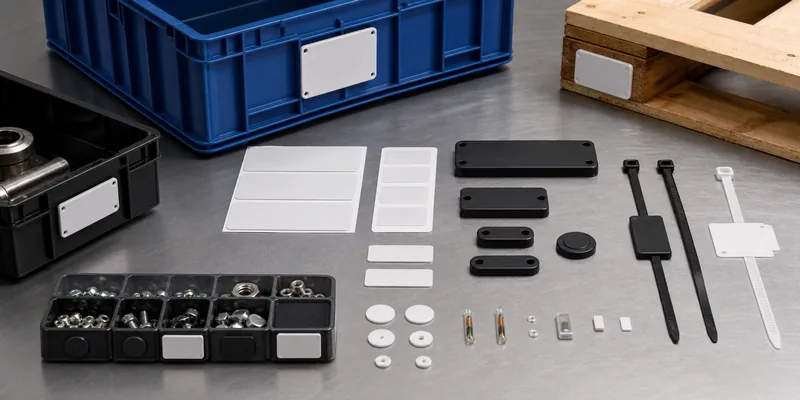
RFID tag options for manufacturing bins, tools, pallets, and small components

Manufacturing object Common RFID option What to confirm before ordering
Plastic bins and totes UHF RFID labels or durable stickers Read distance, label adhesive, curve radius, cleaning exposure, and encoding format
Metal tools and fixtures Anti-metal RFID tags or hard tags Mounting method, thickness, impact risk, reader distance, and tag orientation
Small components Small RFID tags, compact labels, or HF/NFC tags Available surface area, memory need, read zone size, and whether group reading is required
Pallets and returnable racks Long-range UHF tags or rugged hard tags Outdoor exposure, attachment, forklift read points, and regional UHF frequency range
Finished goods packaging UHF RFID labels or printed RFID stickers Packaging material, printer/encoder compatibility, EPC serialization, and customer data rules

For adhesive manufacturing labels, review WXR’s RFID stickers and labels. For antenna format and wet/dry inlay decisions, the RFID inlay category is a useful next step. If the item is metal, start with anti-metal RFID tags.

Frequency Selection: UHF, HF/NFC, or LF?

UHF RFID is commonly selected for manufacturing inventory because it supports longer read ranges and faster group reading than HF/NFC. It is the usual choice for dock doors, pallet movement, bins on conveyors, and finished goods inventory. For buyers comparing UHF options, WXR’s 860-960 MHz UHF RFID tags page is the most relevant product path.

HF/NFC can make sense when the operator intentionally taps or reads one item at close range, such as maintenance verification, operator instructions, sample identity, or phone-based inspection. LF is more specialized and is less common for general manufacturing inventory. For a broader technical comparison, use WXR’s guide to LF, HF, and UHF frequency differences.

Metal, Oil, Heat, and Mounting Surface Matter

Manufacturing environments are rarely as friendly as a clean office asset-tracking test. Metal can detune a normal RFID label. Oil can weaken adhesives. Curved surfaces can bend the antenna. Heat, vibration, abrasion, or wash-down cleaning can damage a tag that looked fine in a sample photo.
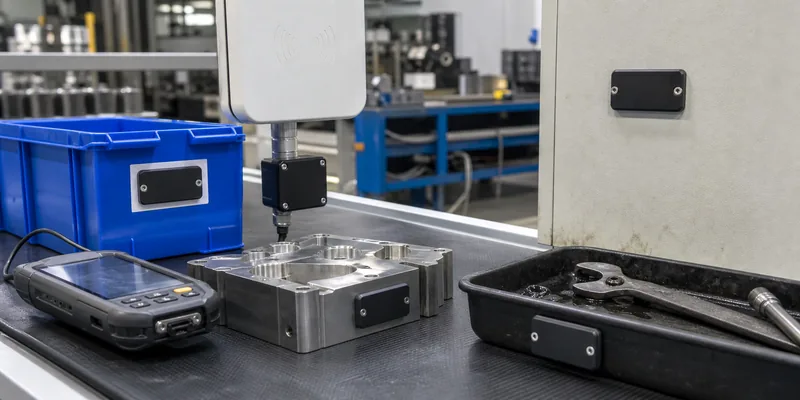
RFID manufacturing surface testing on metal fixtures, plastic totes, and tool trays

Before ordering bulk RFID tags, prepare a surface map. List object type, material, flat area, mounting direction, temperature, cleaning process, mechanical contact, and outdoor exposure. Ask the supplier to recommend samples against that map, not against the application name alone.

For tools, machines, fixtures, and IT or maintenance assets, also compare asset tracking RFID tags. If the project includes outdoor racks, wet processes, or washable containers, review waterproof RFID tags and verify the actual cleaning and exposure conditions before publishing a specification.

Define Encoding and Data Rules Early

In a manufacturing project, the physical tag is only half the decision. The other half is what the ID means to your software. A UHF tag may carry an EPC, and some projects also use TID or User memory depending on the workflow. Avoid leaving encoding rules until the day before mass production.

Clarify these items before the sample order:

  • Whether each tag needs a unique serialized EPC, a printed barcode, a QR code, or human-readable number.
  • Whether the RFID ID maps to a work order, fixture ID, tote ID, tool ID, batch, or finished item.
  • Whether data is encoded by the tag supplier, printed and encoded in-house, or written at first use.
  • Whether the system needs to read only EPC, verify TID, or use additional memory.
  • Whether failed reads, duplicate reads, and exception events have a clear handling rule.

If your team is still defining EPC, TID, and memory fields, WXR’s article on TID memory in RFID is a useful technical reference.

Build a Pilot Test Before Bulk Production

A useful RFID pilot does not only ask, “Can the reader see the tag?” It tests whether the tag can be read consistently at the real process point, with the real object, in the real orientation, while operators work normally.
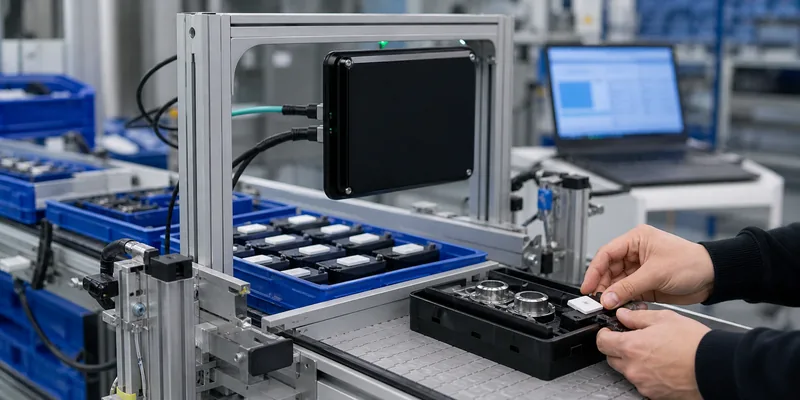
RFID pilot read point for tagged parts moving through a manufacturing workflow

Sample Test Checklist

  • Test each tag on the real material: plastic, metal, cardboard, coated parts, racks, or tools.
  • Try the expected tag position and at least one fallback position.
  • Measure reads at the actual reader distance and antenna angle, not only at a desk.
  • Check single-item reads and multi-item reads separately.
  • Run the test after handling, cleaning, movement, or heat exposure when those conditions apply.
  • Record no-read zones, misreads, duplicate reads, and operator steps that create errors.

For read-distance planning, also review WXR’s guide to RFID read range and sample testing.

Questions to Send an RFID Tag Supplier

A strong RFQ should give the supplier enough detail to recommend the tag format without guessing. Include the application, object material, available tag area, target read distance, reader type if known, expected environment, print or encoding needs, quantity range, and sample-test plan.

For example, “RFID for manufacturing inventory” is too broad. A better request is: “We need UHF tags for reusable plastic bins moving through three read points in an assembly line. The flat label area is 60 x 25 mm, target read distance is 1.5 m, and each tag needs serialized EPC encoding plus a printed number.” That gives the supplier a real specification to work with.

WXR can help compare RFID labels, anti-metal tags, small RFID tags, and UHF inlays for manufacturing use. Send your object photos, surface details, reader setup, read-range target, printing design, and encoding rules through the WXR contact page so the team can suggest samples before mass production.

FAQ

What is the best RFID tag for manufacturing?

There is no single best tag. UHF RFID labels often fit bins, packaging, and pallets, while anti-metal tags are usually needed for metal tools, fixtures, and machine assets. The best choice depends on material, read distance, mounting method, and the event being tracked.

Can RFID tags work on metal tools?

Yes, but standard RFID labels usually perform poorly on metal. Use anti-metal RFID tags or a tested spacer/mounting method, then verify performance with the actual tool shape, reader distance, and storage layout.

Should a manufacturing project use UHF or NFC tags?

Use UHF when you need longer-range or multi-item reading, such as bins passing a read point or pallets moving through a dock. Use NFC or HF when the operator needs deliberate close-range interaction with one item.

What information should be encoded into manufacturing RFID tags?

Most projects need a unique ID that maps to the software record. Depending on the system, this may be an EPC, a tool ID, a tote ID, a work-order link, or another serialized identifier. Confirm the data rule before ordering encoded tags.

How should buyers test RFID samples before a factory rollout?

Test tags on the real item, at the real read point, with the expected mounting position and workflow speed. Record failed reads, orientation problems, surface issues, and operator handling problems before approving the final tag.


RFID Read Range: What Affects It and How to Test Tags Before Buying

RFID read range is not a fixed number printed on a tag. It is the distance at which a specific tag, reader, antenna, object surface, and environment work together reliably enough for the job. A UHF label that reads well on a carton may fail on a metal tool. An NFC tag that works perfectly with a phone may be the wrong choice for warehouse portals. Before buying custom RFID tags in bulk, treat read range as a test result, not only as a catalog claim.

This guide explains the main variables that affect RFID read range and gives buyers a practical sample-testing plan. If you are still comparing frequency options, start with WXR’s guide to LF, HF, and UHF frequency differences, then use the checklist below to prepare your project details.

RFID tags tested on metal cardboard and plastic surfaces

Quick Answer: What Controls RFID Read Range?

The biggest factors are frequency, tag antenna size, chip sensitivity, reader power, antenna type, mounting surface, tag orientation, surrounding metal or liquid, and how many tags must be read at the same time. Passive tags also need enough energy from the reader field to power the chip, so a longer read zone usually requires the whole system to be designed around that goal.

For buyers, the practical question is not “What is the maximum range?” A better question is: “Can this tag be read consistently at our required point in our real workflow?” That wording keeps the discussion grounded in cartons, tools, garments, books, vehicles, laundry bags, or other real assets instead of ideal lab conditions.

Frequency Sets the Starting Point

RFID frequency has a major influence on read distance and use case. LF tags are commonly used for close-range ID, animal tags, and access systems. HF and NFC tags are often chosen for cards, library labels, phones, and short-range user interactions. UHF RFID is usually selected when projects need longer read zones, faster inventory scanning, or portal/handheld reading across many items.

FrequencyTypical buyer goalRead range noteWhat to confirm
LFAccess ID, animal ID, close-range credentialsShort, controlled readsReader compatibility and chip type
HF / NFCCards, library, phone tap, smart packagingShort to moderate near-field readsISO standard, memory, phone or reader behavior
UHFWarehouse, apparel, asset tracking, portalsLonger read zones are possible but environment-sensitiveSurface, antenna, orientation, region, and software workflow

If the project requires long-distance inventory or asset tracking, review WXR’s UHF RFID tags and asset tracking RFID tags. If the project is phone interaction or short-range authentication, an NFC or HF format may be more suitable even if it does not read from far away.

Surface Material Can Change Everything

The same RFID tag can behave differently on cardboard, plastic, glass, metal, fabric, or liquid-filled packaging. Metal can detune a normal RFID antenna or reflect the signal in unexpected ways. Liquids and the human body can absorb RF energy, especially when the tag sits very close to water-rich materials. Curved surfaces can also bend the antenna and change performance.

This is why a buyer should tell the supplier the exact mounting surface before asking for samples. For metal tools, IT equipment, gas cylinders, racks, or machinery, compare normal labels with anti-metal RFID tags. For cartons, packages, documents, and general logistics, RFID stickers and labels may be a better balance of size, cost, printing, and encoding.

Tag Size, Antenna Design, and Chip Choice Matter

A larger antenna can often harvest and return more energy than a very small antenna, but size is not the only factor. The tag’s antenna design, chip sensitivity, tuning, material stack, and adhesive all affect performance. A tiny jewelry tag, a laundry button tag, and a large UHF label should not be expected to deliver the same read range, even if they use the same frequency family.

Chip selection matters too. Some projects need EPC memory only; others need TID verification, user memory, password locking, or NFC NDEF data. If read distance and memory are both important, discuss both requirements early. Do not choose a chip only because it is familiar; choose the tag format and chip together.

RFID sample testing kit for buyer validation

Reader, Antenna, and Software Settings Also Affect Results

Read range is a system result. A tag tested with a high-performance fixed reader and a properly aimed antenna may perform differently with a low-power handheld reader. Antenna polarization, reader power, reader sensitivity, cable loss, scan speed, and filtering rules can all change what the operator sees. In dense tag populations, software settings and anti-collision behavior also affect read reliability.

For this reason, the best sample test uses the reader and antenna that will be used in the real project. If that is not possible, record the test reader model, antenna type, power setting, distance, angle, and environment so results are not misread later.

A Practical RFID Read Range Testing Plan

Before mass production, prepare a small test plan instead of checking one tag once. The goal is to find a reliable operating window, not a one-time maximum distance.

  • Define the required read point. For example: handheld scan at shelf level, portal read at dock door, phone tap on packaging, or access credential at a reader.
  • Test on the real asset. Attach the sample to the actual material: metal, plastic, textile, glass, paper, wood, or liquid container.
  • Try several positions. Move the tag across corners, flat areas, curved areas, and hidden locations if the project needs embedded tagging.
  • Test orientation. Rotate the tag and asset because antenna alignment can change results.
  • Measure repeatability. Check whether the tag reads consistently across multiple passes, not only once at a best-case angle.
  • Simulate the real workflow. Add nearby items, stacked cartons, moving pallets, people, metal shelves, or other interference sources.
  • Record encoding and printing needs. Confirm EPC, UID, serial number, QR code, barcode, logo printing, and lock settings before production.
RFID warehouse portal read zone test with tagged cartons

Common Mistakes When Comparing RFID Read Distance

The first mistake is comparing tags without specifying the surface. A normal UHF label on a carton and an on-metal tag on a steel tool are solving different problems. The second mistake is chasing the longest possible read range when the workflow needs a controlled read zone. For access control, payment, or item confirmation, too much range can create accidental reads.

The third mistake is ignoring regional frequency and reader settings. UHF RFID regulations vary by market, so a tag and reader setup should match the deployment region. The fourth mistake is treating a sample result as permanent without checking production variables such as printing, adhesive, lamination, encoding, and final mounting method.

What Information Should You Send to an RFID Tag Supplier?

To get useful tag recommendations, share the application, target read distance, reader type, frequency preference, asset material, tag size limit, environment, attachment method, quantity, printing, encoding, and packaging requirements. Photos or drawings of the asset help the supplier avoid unsuitable tag formats early.

WXR can help compare custom RFID labels, inlays, anti-metal tags, cards, wristbands, laundry tags, and other tag formats based on your surface and workflow. If read range is critical, contact WXR with your test conditions and sample requirements before mass production.

FAQ

What is a good RFID read range?

A good read range is the distance that reliably supports your workflow. A phone-tap NFC project may need only close contact, while a UHF warehouse portal may need a larger read zone. The right answer depends on frequency, reader, antenna, tag, surface, and environment.

Why does my RFID tag read well in one place but poorly in another?

The mounting surface, nearby metal or liquid, tag angle, reader antenna position, and surrounding interference may have changed. Test the tag on the real item and in the real workflow before deciding it is suitable.

Do anti-metal RFID tags always read farther?

No. Anti-metal RFID tags are designed for metal surfaces, but the best choice still depends on tag size, reader setup, mounting position, and target read zone. They should be compared with samples on the actual asset.

Can WXR customize RFID tags for a target read distance?

WXR can recommend tag formats, chips, materials, printing, encoding, and sample options based on your application. Exact performance should be verified with samples in your reader environment before rollout.

Schema Recommendation

Recommended schema: Article and FAQPage. The FAQPage schema should match only the visible FAQ questions and answers above.

Facts and Assumptions to Verify

  • Exact read range must be verified with the buyer’s reader, antenna, asset surface, and environment.
  • Regional UHF frequency rules and reader power settings should be confirmed for the deployment market.
  • Chip availability, material stack, encoding, printing, and locking requirements should be confirmed before production.

Ask For A Quick Quote

Your inquiry will be replied within 24 hours! Please pay attention to the email with the suffix “@tag-rfid.com”. If not received, please check your spam email.